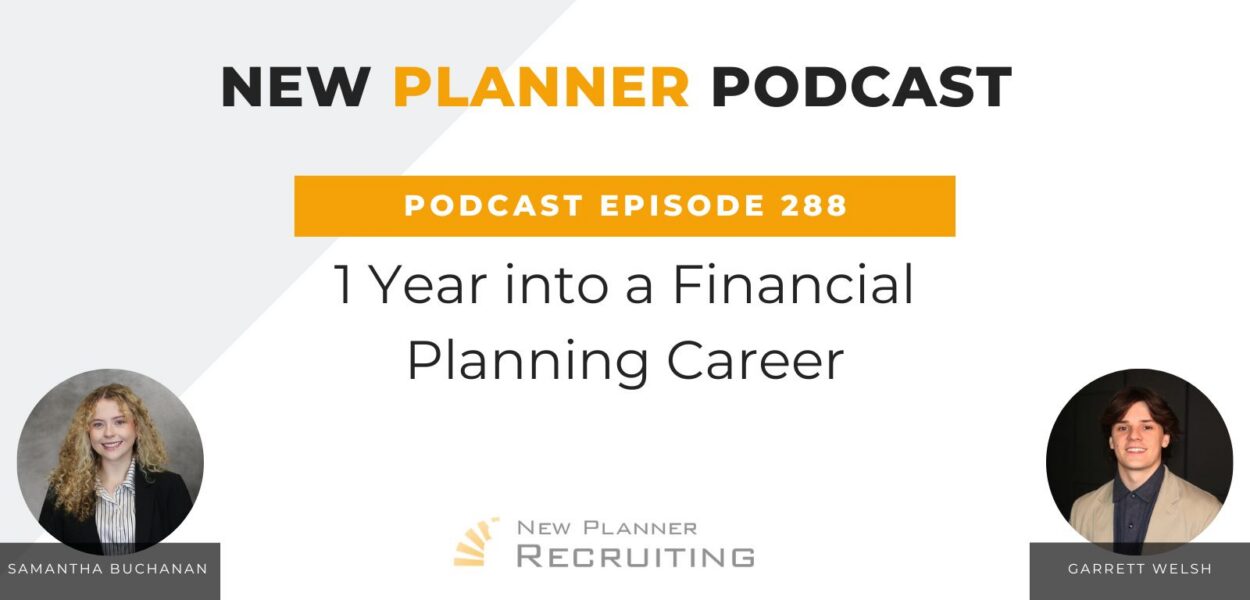
How can you build a successful financial planning career in your first year after college? In this episode, I sit down with paraplanners Samantha Buchanan and Garrett Welsh from Allegiance Financial Group Advisory Services to explore their journeys into financial planning, how they chose the right firm, and what they’ve learned transitioning from students to professionals.
Listen in to learn how Samantha and Garrett evaluated career opportunities, why finding the right firm culture mattered, how paraplanners can contribute value from day one, and how technology like AI is changing (but not replacing) the human side of financial advice. You'll also hear practical advice for aspiring planners, including how to build confidence in client meetings and create your own career opportunities.
What You'll Learn In Today's Episode:
- How Samantha and Garrett discovered financial planning as a career path. (1:15)
- How they evaluated different firm models and chose the RIA path. (4:10)
- What new planners can contribute immediately after joining a firm. (6:05)
- How AI can support planners while preserving the human side of advice. (7:30)
- How Samantha and Garrett overcame fears when transitioning from college to professional life. (9:15)
- What daily responsibilities look like for paraplanners supporting advisors and clients. (13:35)
- How strong mentorship and culture help new planners build confidence. (17:00)
- Why earning credentials like the SIE, Series 65, and CFP can accelerate your career. (27:20)
- Advice for students and career-changers looking to break into financial planning. (30:34)
Ideas Worth Sharing:
“You’re not really going to, as a financial advisor, be replaced by AI. You might be replaced by someone who knows how to use it though.” - Garrett Welsh Share on X “Your comfort zone is where dreams go to die.” - Garrett Welsh Share on X “You have to create opportunities for yourself. You have to get yourself in rooms to be talked about and noticed.” - Samantha Buchanan Share on XResources In Today's Episode:
- Samantha Buchanan: LinkedIn
- Garrett Welsh: LinkedIn
- Allegiance Financial Group Advisory Services
- New Planner Recruiting - Financial Planner Career Roadmap
- Finding your Path: The Roadmap from Student to Successful Financial Planner by Caleb Brown
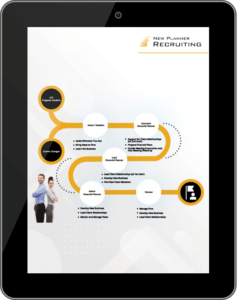 Download your free copy of the New Planner Career Roadmap! In this roadmap, you'll be guided through the details of various stages of your financial planner career, including position descriptions, licensing, skill and experience level requirements, and compensation ranges.
Get the Full Episode Transcript:

Read the Transcript Below:
Welcome to the New Planner Podcast, where it's all about helping you successfully enter the financial planning profession and accelerate your financial planning career. This podcast will help you understand the profession, become familiar with the various career paths available to you, and avoid the mistakes that limit your success. Join your host, Caleb Brown, to explore the human side of creating a successful planning career through interviews, personal experience, and insights from the trenches. Let's get started.
Caleb Brown: Welcome to the New Planner Podcast. This is Caleb Brown, your host. I'm joined today by Samantha Buchanan and Garrett Welsh, who are both paraplanners at Allegiance Financial Group Advisory Services. They both join the show today to share their career entry points and discuss their experiences one year into a financial planning career. I hope you enjoy this episode with Samantha and Garrett.
Hi, Samantha. Hi, Garrett. Welcome to the New Planner Podcast.
Samantha Buchanan: Hi, Caleb.
Garrett Welsh: Hey, Caleb. How you doing?
Caleb Brown: I am doing great. Hey, this is going to be so fun. I have been looking forward to this, I mean, ever since we worked together, well, about a year ago. So Samantha, I want to start with you. How did financial planning... Why did you even consider this as a career?
Samantha Buchanan: So pretty early on into school I knew that I needed to change my major. I was very ambitious and thought that I was going to be pre-med, and I got weeded out of the weed-out bio class, so I knew that that wasn't working. And I thought, “Well, you know, I like math, so what can I do there?” And I thought about, like, taking the route of an actuary, but I just wanted... I knew I wanted to talk to people. So, and then this girl, I was interviewing people to be roommates with, and I met this girl, and she told me, “I have a friend in financial planning. She loves it.” That girl was not my roommate. Don't even remember her name. But I did end up sticking with financial planning, and I just loved it. I mean, like, I love the psychology behind money and what it means for people. Why do people make decisions that they know aren't the best for them when they know what they should be doing instead? So I just, I really like the people aspect, and I'm a big nerd. I like Excel. I budget on Excel. So I just love the numbers and people.
Caleb Brown: Wait a minute, you actually do a budget? People still do that?
Samantha Buchanan: I do, yeah. Okay. Like, I'm, I'm not using an app.
Caleb Brown: I'm just kidding. Thank you for walking us through that. Garrett, what about you? How did you get interested in this?
Garrett Welsh: Yeah, so kind of similar to Samantha, I'm a nerd by default. You know, kind of grew up loving numbers and math, and math was always my favorite subject. But I also played a lot of team sports growing up, like football, basketball, lacrosse, and I loved my coaches, all of them. I don't think I had a bad coach. I was super lucky. And professionally, I found out that a lot of my favorite coaches were financial advisors. They were great people persons, great leaders, great talkers. They knew how to calm you down or get you fired up. So I thought that was really, really cool. I kind of saw myself in them, kind of being a leader, bringing people together, and that combined with my love for math, it kind of made sense to be a financial advisor. So I tried it out in school and ended up loving it. It meshed so well with my background and my interests, and it just kind of felt natural to me, so, and it transitioned pretty well to the workforce, so yeah.
Caleb Brown: Yeah, combining that people aspect with the analytical aspect, right? I mean, it's the best of both worlds, so. Okay, Samantha, I want to come back to you. So you're, you're at UGA, and you're about to graduate. You could've gone anywhere, to any type of firm, any size of firm, any channel. How did you narrow it down to what you thought was a good fit for yourself?
Samantha Buchanan: Well, Caleb, truthfully it came down to your practice management class. I mean, the other classes in the curriculum, they're great for learning different textbook things, but your course was the only one that touched on what kind of firm do you wanna work for. When we talked about silo versus ensemble, I knew I wanted to be for an ensemble. I knew I wanted to be fee-based. I didn't wanna have to sell products or build my own book. So it really came down to a great professor and a great class.
Caleb Brown: Oh, that, we're gonna have to edit all that out because they're gonna... My audience is gonna send me nastygrams. I appreciate you saying that, but— Okay. Because there's a lot of options, right? And maybe Garrett will bring you in. I mean, it can be a little overwhelming. So how did you, and maybe we'll just a little more, how did you figure out you wanna go the RIA route? Yeah.
Garrett Welsh: So I, I interned with another RIA, and I really liked the structure, and then I interviewed with a few firms that were more, like Samantha said, sales-based, uh, build-your-book base type of firms. And I kind of, you know, weighed the pros and cons of both, and I was lucky enough to find this firm where it was small enough to be able to make an impact. You know, we don't have a ton of employees. But big enough, and tenured enough and, you know, structured enough to be a well-oiled machine. So being here at this early stage where it still feels like a startup, yet it has a great foundation, I'm really lucky to find a firm like this to where, you know, they have sizable clients, really nice clients, a lot of experience, but, you know, still able to learn a ton and kind of impact them in my own way by bringing my experiences as, you know, Gen Z, as Samantha and I like to say.
Caleb Brown: I appreciate that. And let's just stick with you, Garrett, for a minute. I mean, I hear that, but this outside of a solid financial planning education, University of Delaware, right? Isn't that where you went? University of... And then a couple internships. I mean, what value are you bringing to the firm? What are you doing for them?
Garrett Welsh: Right. I think one of the big things was being able to hit the ground running with eMoney, not having to be trained a ton on that, already having a background in that where I would take, you know, exams in school on eMoney. It was kind of structured into that. So being able to hit the ground running and instantly run that software in client meetings and build it out for the team was super, super helpful. Also, the use of AI in school, you know, using that to assist with writing, studying, things like that, being able to implement that. I know Samantha disagrees with my methods on that, but being able to implement that so far to help out has been pretty instrumental in my opinion.
Caleb Brown: Like you're helping the other advisors and the other employees in the firms implement these AI tools. Is that what you're saying?
Garrett Welsh: Right. Right. Exactly. Okay. More to come in the next few months. I'm actually working on a project right now. But yes, I think it has helped me with background research and planning, being able to do things quicker than ever. Outsourcing these tools has really helped translate to the meetings and planning.
Caleb Brown: But let's stay on that for a minute because there's a lot of articles in some other fields. I mean, entry-level hiring has gotten absolutely decimated because of AI tools, and that's leaking over, and you're starting to see some of that in financial planning. So maybe, Garrett, stay with you. What's your response to that when you're talking to someone like, “Garrett, how am I gonna get an entry-level job if you're using all these AI tools?”
Garrett Welsh: Right. So I would say that it's, it's more of a helper. You're not really going to, as a financial advisor, be replaced by AI. You might be replaced by someone who knows how to use it though. I think if people wanna bring the argument of, “Oh, why don't I use a robo-advisor to just manage my finances?” You could do that. That's a cold hand to hold though, right? You want a human talking you through, you know, handling your money and being able to have that therapy side of it.
Like I said, it's good for background stuff, but really to have a robot essentially handle your finances is not practical in my opinion.
Caleb Brown: Samantha, what's your take on all that?
Samantha Buchanan: I mean, I completely agree. People wanna talk to people. I know, you know, there are all those Bogleheads, and they just invest in the S&P and go about their day, and I think that's fine. But I think for more complex situations or, you know, I don't think ChatGPT is gonna do a good job of talking someone off a ledge when the market's down. And Garrett and I haven't even really seen what that conversation even looks like because since we started, the market hasn't been down more than 6% that we saw in March.
Garrett Welsh: Great point.
Samantha Buchanan: So yeah. I just think that there's a personal aspect that cannot be replaced.
Caleb Brown: Yeah. Samantha, if you would, stay with you. I mean, you're sitting there, your senior year. I mean, you're about to join your firm. What were some of your fears? I mean, did you have... What were your thoughts on transitioning from student to professional, starting at a new firm, moving to a new, ‘cause you relocated, right? To Wilmington?
Samantha Buchanan: Yeah, and that, that was terrifying. I mean, it's scary to go from your college town, and you've got all your friends and all the people that you love and you see every day to a town where you don't know anybody. But I think that as I come out of my comfort zone professionally, it inspires me to do it personally too. So I've really tried to go out of my way and meet new people, and I actually have a few friends here now, which is great. But as far as fears beyond that, I honestly don't recall ever being scared that the firm wasn't a good fit. Like, I had just clicked with Haley so well. She had talked about everybody else so highly that that thought honestly never crossed my mind.
Caleb Brown: That's awesome. Garrett, what about you? Fears for starting your career and, I mean, anything you wanna add?
Garrett Welsh: Yeah, I agree a lot with what Samantha said there with there really were no fears on my end if they were gonna like me or not. At the end of the day, it was kind of a mutual hiring thing. I like them, they like me, and Haley, once again, was super awesome in making me feel at home at this firm. I just felt comfortable here, and Samantha and I agree on this, it is kind of, you know, being the pioneers to move out of their home state and try something new. I think life's too short to stay in your comfort zone. Your comfort zone is where dreams go to die. So I think it was really cool. And also, you know, my parents when they graduated, they're from Ohio, they moved across the country to the East Coast when they were 22. They moved out of state and for a job, and I thought that was really cool just being out of their comfort zone, so I decided to trailblaze similarly.
Caleb Brown: So I want, I want both of you to talk about what was so attractive about Allegiance. I mean, maybe walk us through the interview process and just what clicked and connected with you during that process.
Samantha Buchanan: I guess I'll start. So I had the two things that I was absolutely sure about: I don't want to build my own books, and I don't want to sell products. But beyond that, I like the idea of being a big fish in a small pond versus being thrown into some huge firm where there's, like, 10 different floors in the building. You don't know who you're supposed to ask certain questions to. Like, there's always... If I don't know something, I know exactly who does know that, and I know who to go to. So that, like Garrett said, it's small, but not too small. And also just getting to learn from three different advisors I feel is such a privilege as we come into our careers 'cause we can take different things from each three, take what we like, maybe change certain things, as opposed to only being able to shadow one advisor, and you don't really know any different.
Garrett Welsh: Yeah. Just piggybacking off of that, I'll say they made it very clear that they were gonna build me and the paraplanner role from the ground up. I had not worked anywhere previously full time, and I just kind of wanted to be a sponge and soak everything up, and there was just a roadmap on how to get from essentially base-level finance knowledge to becoming an associate advisor, then eventually, giving that vision to be an advisor.
And another thing that was attractive, now that I've been working here, I would say, is there's, there's no task too small. You know, for a client, if a client wants something done, we'll go out of their way to do it, uh, you know, regardless of if it has to do with planning or not. Like, Asaf, one of our partners here, he even goes and helps clients negotiate their car buying. When they're going to buy a new car, he'll go and pester the salesman. So there's no task too small with this firm. It's great. It's really the full package.
Samantha Buchanan: Yeah. Every day looks different too, which is nice, I think. And at some other firms, maybe somebody in our position is only debriefing meetings, but that's really just a small portion of what we do.
Caleb Brown: And let's stay on that if you would, Samantha. Just walk us through. So you're both paraplanners. Garrett, you started a little bit... I mean, it's kind of a cohort though, right? You were kind of hired at the same time. You started a little bit before Samantha did 'cause we were waiting on her graduation. But describe a day. I know you said a different, but what are your core responsibilities? What are you doing each and every day?
Garrett Welsh: I'll go first. So today's Monday, for instance, is you know, the day of the week where you're setting up your meetings. You're making your agendas for your client meetings, you know, meeting packages, quarterly, you know, statements for the clients and reviewing their, their eMoney and things like that. But some days, when you don't have client meetings, you're doing kind of background work maybe. We're doing a lot of cleanup in our Google Drive right now that needs help.
You know, clean up some Excel sheets from this book we're transferring over. There's always things to do, always things to clean up, and always people to help. When our coworkers, you know, our client services associates, when they're backed up with activities, I'll take some of their activities over and help schedule meetings, send emails, get in contact with clients. It's really, there's no such thing as, you know, “not my job,” is what we say. It's kind of an all-around thing.
Samantha Buchanan: Yeah. And also, like, a lot of research for advisors. Just anything that we can do to make their day a little less stressful. I'm looking at about 13 or 14 documents right in front of me that need to get uploaded, and looked through. So I'm doing that. And yeah, reaching out to clients, reaching out to prospects, getting meetings scheduled, whether that's through a link or some people need to be scheduled manually. Whatever they need, really.
Caleb Brown: Got it. And talk to me about your, maybe Samantha, we can stay with you, your involvement in the client meeting process. You said you reached out to clients, prospects. I mean, are you doing the meetings? Are you supporting, and with the advisors? Or, walk us through that.
Samantha Buchanan: Yeah. I think... Well, Garrett and I just both passed the Series 65, and we're in the process of getting us registered and licensed.
Caleb Brown: Congrats.
Samantha Buchanan: Thank you. So it's still mainly a support role, but Charlie is really great about letting go of the reins. Like, he has given me the platform to feel comfortable speaking up in client meetings and asking questions and knowing which questions should be asked during the meeting and which questions should be asked after the meeting, not in front of the client. So yeah, I think it really just depends. Obviously, we're not giving advice, but we might be contributing to a conversation about it. I actually did have a client meeting where the client asked me, “Samantha, what would you do in my shoes?” So that was pretty cool.
Caleb Brown: Whoa.
Samantha Buchanan: Yeah.
Caleb Brown: What'd you tell him?
Samantha Buchanan: I said—well, he's in his 40s. I said, “I'd probably be way more aggressive than you, but if you wanna let things settle, we could ease into increasing your risk tolerance a little bit.” And he thought that that was a good idea.
Caleb Brown: But you know, Samantha, that's a good sign that the client is doing that. That means you're positioned, in my view, they're positioned correctly, not just looking at you as like, “Oh, it's just a new person out of Georgia,” and they're, you know, “I'm not really gonna be able to listen to them until they have 10 years under their belt.” So maybe talk about that. You mentioned Charlie, your senior advisor. How is he positioning you? And then how have you developed the confidence to be able to talk in some of these meetings and, and, and connect with the client?
Samantha Buchanan: He is really good at talking me up. He always introduces me, says things like, “She's way smarter than I am.” So he's just very humble and kind like that. And also, he brought me to a dental mixer. I think, you know, we have a dentistry niche. So we went to that, he introduces me to everybody. So he really just makes sure to tell people, “Samantha's here,” and introduce me, say, explain my role. Sorry, I don't have more than that.
Caleb Brown: That's great. Yeah, that's all good, all good stuff. Garrett, what about you? I mean, what's your involvement? Because you're in the Washington, DC office. So is everything exactly the same over there or is it a little bit different?
Garrett Welsh: Yeah, it's different between, you know, Charlie and the two advisors up here. I like that our role is very fluid. If I need Samantha to cover for one of my meetings, she's more than happy to hop in on them, and vice versa. And the advisors have very different styles of how they lead meetings. Like she said, Charlie likes to give us the reins a lot more and let us kind of present a little more, whereas up here it's a lot of debriefing, keeping track of everything, and very different client bases between the three. But each of our like three advisors, I would say, do a really good job of helping us get rid of that imposter syndrome where you're fresh out of college. You don't know if you belong in this room, but at the end of the day you, you are the professional in the room. That's why you're hired, you know? That's why the client is coming to you and not the other way around, you know. You have the knowledge. You went to school, you passed the test, right? You are the professional in the room. So I think the three advisors do a great job of helping us feel confident and structured, and like I said, getting rid of that imposter syndrome. Like, we truly belong here.
Samantha Buchanan: Yeah. And every time we get good feedback, I think that cures the imposter syndrome as well.
Caleb Brown: Yeah. What's been the most enjoyable... Just looking back over since you got out of school and you started your first job in financial planning, what's been the most enjoyable part of the career thus far?
Samantha Buchanan: I think the team. Is that okay to say? I really think the team is the best part of this job. I don't get the Sunday scaries. By the time Sunday night is here, I'm genuinely excited to go to work Monday morning. I love the people we work with. I call some people in our DC office just to chat, that we're not in the same position so we wouldn't have a scheduled meeting to chat, and I'll call them up and chat for 15, 20 minutes just to get to know them outside of just work. But, of course, like Garrett said, if we need something done, there's so much communication between the two offices that everybody is gonna be available for you.
Garrett Welsh: Yeah. I agree 100%. What she said about the Sunday scaries, I was thinking last night, I don't dread Sunday nights anymore like I did when I was going to school and stuff. “Ah, Monday I gotta go to class tomorrow.” I really don't dread it, going to work. I like this team. And Samantha, I met her for the first time in person in May, but she had joined in January, and I felt like I knew, I felt like we knew each other. I felt like I could... we're friends, and we hadn't even seen each other in real life. So that was really cool, and I was lucky enough to join right in time for our team retreat, where we went out on a boat, and that absolutely sealed the deal for me. The team was just so cool and relaxed, and seeing everybody outside of a work environment and just, “Oh, this person's cool,” right? Not just my coworker, this person's like a friend, was really important for me.
Caleb Brown: You both mentioned how you don't have the Sunday scaries, and that's awesome. That really is. Because most of the American workforce has that.
Samantha Buchanan: Yeah.
Garrett Welsh: Absolutely.
Caleb Brown: But let's just... I wanna plow it, push back a little bit more. So you've got a difficult, a client's upset. You know you gotta talk to them on Monday. You've got 17 items you've gotta review by lunchtime on—like, you're still not having the Sunday scaries with those scenarios?
Samantha Buchanan: No. 'Cause those days go by so fast. If you got a full to-do list, the day's gonna go by so fast. And truthfully, Caleb, if there is an angry client, it's not me or Garrett that's gonna be talking to them, it's gonna be a lead advisor.
Garrett Welsh: Yeah, that's true. That's true. I would say not every day is perfect. There's some days where it's like tomorrow's gonna be rough or today was rough or I had a rough day, but I don't really dread, there's no dread there. It's more like anticipation to solve that puzzle.
Caleb Brown: Well, and it's still called work. It's called work for a reason. It's not a leisure.
Garrett Welsh: Exactly, yeah. It's not a hobby, yeah.
Caleb Brown: That's interesting you just said that. “I like to solve the pu—” I think that's really cool, Garrett, that you said that because that's what it is. At the end of the day, these client situations are just one big puzzle.
Garrett Welsh: Mm-hmm.
Caleb Brown: And then getting that figured out, but also managing their emotions, right? What you guys talked about at the top of the episode. All good stuff so far. Thank you for walking through. So culture, maybe a little bit more on the culture. I've heard fun. I've heard sort of cool, relax. Is that what appeals to you guys as, as well? Anything else on the—how would you recommend somebody looking for a job find the right culture fit?
Garrett Welsh: That's a good question. I would say you don't really know until you get there. They can put on a good face in an interview and say they do this, say they do that, but you don't really know until you probe around for yourself. I can walk into some of the guys' offices here and just ask about the game that happened this past weekend and their opinion, and we'll get into a bit, a debate about whose sports team is better and things like that. That's what kind of proved it to me that the culture was there. If you can have a debate about something that isn't finance, you can talk about hobbies, interests, things like that. So you gotta probe around for yourself in my opinion.
Samantha Buchanan: Yeah. And I'll add on to that and say that I think it's weird to work with people and not know anything about their personal lives. To think that I could talk to somebody every single day and it still just be completely professional, that's not the kind of environment that I want to be in.
Caleb Brown: Yeah. I can relate to that. So let me ask you this: when a mistake is made, 'cause they're inevitable, we're humans, how is that handled?
Samantha Buchanan: Talk to Haley. Actually, I did just, I'm working through this mistake. It's not my mistake, but it's a mistake that I caught, and yeah, I'm kinda just being told, “Talk to the higher-up,” but I noticed this is a mistake. It needs to get corrected immediately. Yeah. I don't know what the next steps will be to, as far as it goes with communicating to the client what this mistake was about. But so far, I have not seen anything drastic. If, for example, a mistake that comes to my mind is misspelling Garrett in an email, and I think he got over that.
Garrett Welsh: I did do that once.
Samantha Buchanan: Hopefully, he got over that.
Garrett Welsh: I'm over it. I'm over it.
Caleb Brown: One R instead of two or one T instead of...
Samantha Buchanan: Yeah.
Caleb Brown: Yeah.
Garrett Welsh: Yeah.
Samantha Buchanan: I was just so excited about the topic.
Garrett Welsh: Yeah. I'll speak to that. I'll speak for this office up here in DC when I say there's... When mistakes are made, or when I make a mistake, you don't sweep it under the rug. You just address it directly. If I have a meeting with an advisor and I make a mistake in the meeting, or something I did after, they'll walk right up to my office and say, “Hey, we need to fix this now,” address it directly. And I would almost prefer that rather than, “Oh, he'll get it next time. I don't need to say anything.” Let's nip it in the bud. Let's solve that problem right then and there and address it so that it doesn't happen again. And I almost kinda prefer that.
Caleb Brown: Yeah, it's something, there's a lot of psychology that backs this up, but, like, when it's fresh, right when it happened versus waiting—oh, I got six other meetings—waiting two days or whatever. It just doesn't have the same. All right, so what, the career track, what is next for you. You're in this paraplanner role, and it sounds like you guys are doing really well on that. Is there a progression, or what are you guys trying to work on or get up to?
Samantha Buchanan: So I think that we will each be in this role for another year or two, but, and Garrett, correct me if I'm wrong, I think we both wanna take the CFP exam in March of next year. So yeah, I think that's the priority on our horizons is passing the CFP exam. And then hopefully, after that happens, we can start talking about moving into the associate advisor role.
Garrett Welsh: Yeah. Associate advisor is mapped out as two-plus years or whenever you're ready. And it's a very clear career path. They have a presentation, kind of PDF of what you need to do, what boxes you need to check in this paraplanner role to get to the next step, and then on and forward. So I feel like we have the processes, me and Samantha, down. We have that down pretty good of what we need to do, what our day-to-day looks like. We're working on getting more comfortable in those client meetings. There's always room for improvement. Doing more one-on-one with clients, rollover meetings, phone calls, things like that. And I think once they see that in us, that we're comfortable and we know what we're doing, and we have the CFP in our headlights, then we move up the ladder.
Samantha Buchanan: Yeah. And I think what we have on our side that's really good for us is we know the lead advisors want us to move up. And we have so much business. It's best for everybody for us to move up when appropriate.
Caleb Brown: Yes. Yes. That's a good sign. You don't know how many calls I get from people who are like, “Man, my lead advisor doesn't want me to move up. They want me to stay in this position forever. Help me find another firm.” You both said CFP is the next sort of thing that you're working on. How has the firm helped, or have they, and if they have, how have they helped you guys facilitate the CFP learning process and the study process and the exam?
Garrett Welsh: I'll speak from my experiences so far. Samantha was a lot smarter than I was in getting her SIE in college. I did not do that. I kind of procrastinated and came out with nothing. And they helped me get my SIE. I was able to do that in the first two months, and then we both did the Series 65 while working here. And they made it clear that, hey, when you're at work, if you can cram in some studying in between meetings, good for you, but that's something you're doing outside of work. They helped us with the course materials. They bought us the book, the course, the study guide, all that stuff. Checked in with us, made sure, “Hey, how are you doing? How are you progressing? Any problems? Any topics that you don't quite understand?” They're very helpful in that sense, and it works 'cause two IARs sitting here right now that couldn't have done it without this great team.
Samantha Buchanan: Yep.
Caleb Brown: It's always good to have a firm that's got your back on stuff like this. And, but it sounds like they're kinda holding the line, “Look, we're not just gonna let you—we're not gonna pay you to study for till six months. We need you to add value and help with this stuff.” So is that what you guys did? Did you study for the Series 65 and the SIE, in your case, Garrett, and then even the CFP now, outside of work hours?
Samantha Buchanan: Yeah.
Garrett Welsh: Yeah. A lot of weekends, I would say. Sometimes after work. And I even asked, I think, when I was studying. I was like, “Hey, Wednesdays after 3:00 PM, can I just take those two hours and study?”
Caleb Brown: Yeah.
Garrett Welsh: And they said, “No.” They said, “No, you're not doing that.” I was like, “All right. Worth a shot.” So yeah, a lot of Saturdays, Sundays, and after work was what I did.
Samantha Buchanan: Yeah. If I had some time, I would study at work, but I really don't think that I... I don't think that I really did study at work until the two weeks leading up to my exam. And then it was just practice test after practice test when I could. And yeah, there were some late nights and early mornings, but it's done. It's behind us until we tackle the big one. But yeah.
Caleb Brown: What would you guys tell job seekers out there, potential career changers, job seekers, that say, “Well, I really wanna get... I'm not gonna do anything on the SIE or Series 65 or Series 63,” any of the ones that you can get without being sponsored, CFP. “I really wanna get hired, and then I'll get serious about that, and hopefully the firm will pay for it.” What would you tell that person?
Samantha Buchanan: To that I would say, “Well, you're gonna be up against people who did take those exams and pass.” So if they can sleep knowing that, then I don't know, maybe they're not meant for this.
Garrett Welsh: Yeah, I agree. I think the SIE, getting that before you graduate or getting that before you get a job is definitely a great indicator that you're serious about this. If you're Series 65 too, that's even better. But I would say at least get an SIE out of the way to say, “Hey, I'm here. I'm real about this,” I'm sure Samantha can speak to that as would be definitely beneficial.
Samantha Buchanan: Absolutely.
Caleb Brown: If you're looking back at the last year of your career, is there anything that comes to mind kinda like, “Oh, if I would've just known this, man, I would just be, like, so much further along than I am now?” Does anything come to mind there?
Samantha Buchanan: Truthfully, no. I mean, I don't wanna discredit my hard work. Of course, like, all of this came to me through hard work, but I also just feel extremely lucky. To even walk across your graduation stage knowing that you have a job, there's no way that I could question anything that's led up to this point.
Garrett Welsh: Yeah. I would say I walked the stage a little differently with some uncertainty 'cause I did not have a job. So thank you, Caleb, for helping me. I would say what I would do differently was finding a recruiter sooner. I would say find someone who's incentivized to help you get a job because there's such a disconnect right now with people that are looking for jobs and people that are looking for employees. I hear all the time that even in my own friends had such struggles getting jobs after college, yet a lot of firms are having trouble finding hardworking people. So if you find a middleman to just eliminate that disconnect of that empty space there, find someone who's motivated to get you hired, get you a position on your team, I think that's instrumental. I wish I knew that a little sooner.
Caleb Brown: Yeah. And Garrett, we'll stay with you on this one and then let Samantha go, but, and maybe you already touched on this a little bit, but it sounds like both of you are really trying to progress up to that associate advisor, then eventually lead advisor, which is a typical RIA advisory career track. So you're in these meetings with these people that are highly experienced. What do you think you need to work on right now to get to that level?
Garrett Welsh: I need to work on my freestyling a little bit better. Things come up in meetings that you can't anticipate for. Obviously, how the algorithm of how a meeting's gonna go: “Hey, how you doing? Okay, this is how your account's doing. Okay, you're on track.” But for that question that comes out of left field that you don't exactly know the answer to, I need to get better at that and having stuff up my sleeve to, to deal with those questions. And maybe that just comes with more meetings, just getting the reps in, more time under tension like that. And I feel like that will help. But for me, definitely the freestyling part of it.
Samantha Buchanan: Can you give an example? What would you, what do you wish you were prepared for?
Garrett Welsh: If a client says, “Hey, can I roll this account into this account?” Or, “I wanna do this type of exchange. I wanna change my real estate into an ETF. Can I do that? Hey, I had this loss last year. Is this long-term or short-term?” And a lot of times you get... the best answer you can give is, “Hey, let me get back to you. I'll get a team work on that right away.” But I feel like it would be better to give them an answer right then in the meeting.
Samantha Buchanan: Yeah.
Garrett Welsh: But just finding the answer in that moment is something definitely that's to be perfected soon, in the near future.
Samantha Buchanan: Okay. I would say for me, getting comfortable presenting eMoney. I can put stuff into eMoney, I can run the scenarios. But at the end when we show a report, like Brett does a really good... Brett, who is in the associate advisor role in our Vienna office, he does a really good job at telling them exactly what they're looking at, whereas I have not practiced a script for that yet. So that's definitely something that needs to be a priority for me, is that presentation.
Caleb Brown: Appreciate you guys sharing that. And again, appreciate you guys coming on and talking through this with us. And been so fun and very helpful, and I hope our audience gets a lot out of it. I think they will. Samantha, any thoughts, closing thoughts or tips that you'd like to leave the New Planner audience with? Then we'll go to you, Garrett.
Samantha Buchanan: Yeah. As far as tips go, I think for college students, just put yourself out there, take the SIE, pass the SIE, and then just talk to people. I don't know how efficient LinkedIn truly is, so I think it's better to talk to people in class, go to events on campus to find people and, yeah, I would say just you have to create opportunities for yourself. You have to get yourself in rooms to be talked about and noticed.
Garrett Welsh: Yeah. I'll say to all the college graduates out there that are yet to find a job or maybe those people that are going into their senior year in college, don't give up. Keep dealing with that rejection. Your life is based around how you deal with rejection. When one door closes, another door opens, and you gotta believe that. You gotta stick to that. If something doesn't come to fruition, then it simply wasn't meant for you, and you gotta keep rowing the boat and the wind will steer you. So yeah, that's what I'll say. Just you gotta keep the punches in, keep rolling with them.
Caleb Brown: Guys, thanks so much for coming on the show.
Samantha Buchanan: Thanks, Caleb.
Garrett Welsh: Caleb, thank you. Thanks, Caleb. Good to see you.
Thanks for joining us for this episode of the New Planner Podcast. If you are ready to discover the top career paths for financial planners and see which track is best for you, we created a free guide to help you. Grab your copy of the Financial Planner Career Roadmap at newplannerrecruiting.com/roadmap. There, you'll also find more tools and resources all created to help you build a successful financial planning career. Tune back in next week for another episode, and until then, we are here to help you succeed.
Share the Love:
If you like the New Planner Podcast...
Never miss an episode by subscribing via Apple Podcasts, Spotify, Amazon Music, YouTube Music, or by RSS!



Leave a Reply