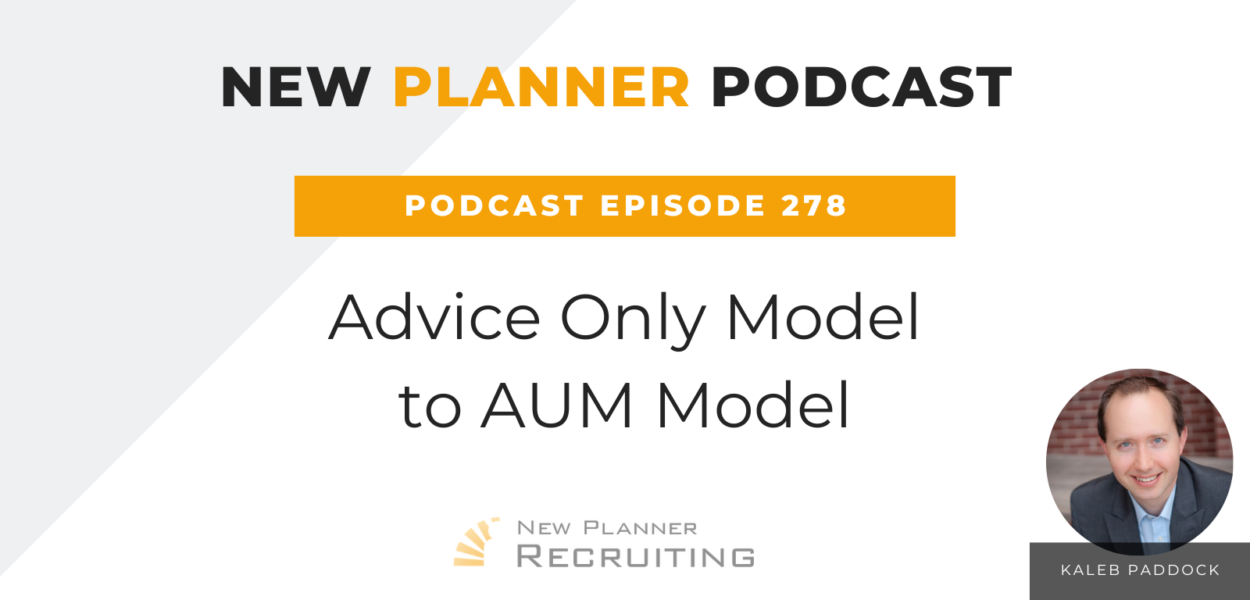
What happens when you stumble into a career you didn’t even know existed and end up building a business entirely on your own terms? In this episode, Kaleb Paddock, founder of Ten Talents Financial Planning, shares his unconventional journey into financial planning and the lessons he learned along the way.
From discovering the profession through third-party administration work to earning his CFP and gaining hands-on experience at an RIA firm, Kaleb walks through the pivotal moments that shaped his career. Listen in to learn how he made the leap to entrepreneurship, the challenges of starting from scratch in a new state, and how he evolved his business model into a virtual family office designed to better serve his clients.
What You'll Learn In Today's Episode:
- How Kaleb discovered financial planning through a TPA role. (3:00)
- Why CFP professionals stood out early in his career. (4:30)
- What he learned working with high-net-worth clients. (11:40)
- Why he chose to leave a stable role and start his own firm. (16:50)
- The challenges of getting clients in a new state. (22:00)
- The evolution into a virtual family office. (28:00)
- Advice for networking, growth, and long-term success. (34:30)
Ideas Worth Sharing:
“People don't hire a firm... they hire a person. And so that really resonated with me—that people are going to hire me based on me, not the firm necessarily that I'm with.” - Kaleb Paddock Share on X “The great thing about this profession is that it does compound on itself. So it's a relationship business, and so relationships compound over time. And I think that is one of the great things about it.” - Kaleb Paddock Share on X “There's just so much good information. Try to consume as much of that as possible. Be super curious.” - Kaleb Paddock Share on XResources In Today's Episode:
- Kaleb Paddock: Instagram | LinkedIn
- Ten Talents Financial Planning
- New Planner Recruiting - Financial Planner Career Roadmap
- Finding your Path: The Roadmap from Student to Successful Financial Planner by Caleb Brown
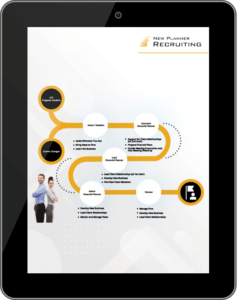 Download your free copy of the New Planner Career Roadmap! In this roadmap, you'll be guided through the details of various stages of your financial planner career, including position descriptions, licensing, skill and experience level requirements, and compensation ranges.
Get the Full Episode Transcript:

Read the Transcript Below:
Welcome to the New Planner Podcast, where it's all about helping you successfully enter the financial planning profession and accelerate your financial planning career. This podcast will help you understand the profession, become familiar with the various career paths available to you, and avoid the mistakes that limit your success. Join your host, Caleb Brown, to explore the human side of creating a successful planning career through interviews, personal experience, and insights from the trenches. Let's get started.
Caleb Brown: Welcome to the 278th episode of the New Planner Podcast. This is Caleb Brown, your host. My guest today is Kaleb Paddock, who is the founder of Ten Talents Financial Planning. Kaleb joins the show today to share his entrepreneurial and financial planning journey. Kaleb shares how he always loved math and ended up joining a third-party administrator after college where he was helping financial advisors with their clients' 401(k) plans.
He thought the financial advisor's job was much more interesting, so he connected with a family friend that owned an RIA firm where he was able to get hired and worked for a few years. Kaleb then goes on to share how he wanted to move to Colorado and start his own firm. He shares how his business model started as advice-only before changing his business model.
Stay tuned to the end to hear how Kaleb struggled to get clients at first, but has since been able to grow his client base and find success. I hope you enjoy this episode with Kaleb Paddock.
Hey, Kaleb, welcome to the New Planner Podcast.
Kaleb Paddock: Hello. Hello. Thank you, Caleb.
Caleb Brown: This is so fun. I mean, I have—anybody that I meet that's named Caleb, I've gotta have him on the podcast. So, so here you are.
Kaleb Paddock: Absolutely. Absolutely.
Caleb Brown: I think you're the first. I may have to go back and look at that. But thanks again for just donating the time, making time for us to come tell your story, and I think it's gonna be a great story. I know a little bit of this already, but I'm looking forward to learning more as the episode unfolds. And if you would just start us off on when you thought you might want to become a financial planner, or when you heard of the financial planning profession and started going down that route.
Kaleb Paddock: Absolutely. Yeah. It's an honor to be on the podcast. I appreciate you reaching out and requesting it. I would also guess probably your first Kaleb with a "K" on our podcast as well, even if there were other Calebs. But no, yeah, so I did not know this profession existed back in high school or college. I did graduate college with a bachelor's degree in finance, but all of the professions I'd heard of were more like bank teller, accountant, just your run-of-the-mill professions that anyone might know of. I did not actually know that financial planning existed other than your stereotypical stockbroker or insurance salesman. So out of college, I was a math tutor in college. Ran that business for a couple years out of college and then through a series of events, met some people and ended up in Walnut Creek, California, where I thought it might be kind of a financial planning job.
It was not. It was a third-party administrator. So these are firms that design 401(k) plans, define benefit plans, and cash balance plans. Some of the people in the audience may have heard of these, or you've worked at an employer that has a 401(k) plan. Well, someone has to administer those, and there's a whole series of regulations. Financial advisors don't touch it. Accountants don't touch it. Bookkeepers don't touch it. It's a niche profession. They're called TPAs, third-party administrators. And the way we got clients as third-party administrators was financial advisors would send us business.
And so I got to know a lot of financial advisors. So that's kind of to your question, like how did I get into it or hear about financial planning—it was through these relationships of people sending us business. And I noticed something; I did this for about four, four and a half years. I would notice something. They would always give me their business card. I would notice that the ones that seemed the most upright and in good standing as humans had these letters after their names: CFP. They all had these letters, CFP, after their name. And all the schmoozey, kind of the schmucks who just did insurance and played golf and didn't really want to do planning, they didn't have those letters. And I just thought, "Oh, this is an interesting observation."
So I started to research. That is how I learned about the Certified Financial Planner designation and kind of started down this path of like, "Okay, how do you become that Certified Financial Planner?" I was not gonna be able to do it—the TPA firm didn't do that. So it was gonna have to be at another firm. And so that was the genesis of that realization.
Caleb Brown: So you're there. That's a really cool story. I'm sure Kevin Keller and the folks over at the CFP Board would really appreciate that.
Kaleb Paddock: Yes.
Caleb Brown: That's really cool. So you were with the TPA firm for what, looks like about four years or something? Is that right?
Kaleb Paddock: Yeah, four. Yeah.
Caleb Brown: Then did you leave there to become a financial advisor somewhere?
Kaleb Paddock: I did, yeah. So I actually ended up becoming—I took a job in Mountain View, so Walnut Creek to Mountain View, just moving further into the peninsula in the San Francisco Bay Area. And the firm at the time was called Stanford Investment Group. They've since been acquired and merged with Aspiriant, and so, great people. Wonderful. That's where I got my training was the folks at Stanford Investment Group. When I joined, they were a hybrid broker-dealer/RIA. And I mentioned that just because with your audience, just understanding the terminology here is important.
They had a history of selling oil and gas deals, real estate deals. Not necessarily like slinging insurance products, but they needed that broker-dealer designation along with the RIA designation. So, hybrid broker-dealer/RIA. Just to do those products. By the time I got there, they weren't doing that anymore. They were pretty much just running the RIA and it was legacy business. But the benefit for me is I got to learn a lot about the dual—it's called dual registration. And a lot of people, depending on how you came into the profession, may not know broker-dealer versus RIA, or the different Series licenses.
So I never had to get Series 7 licenses, life insurance, life and health, because that's just not what they were hiring me to do. I was hired as an associate planner and they were encouraged or excited that I liked to do business development. But the types of clients, as you might imagine in Silicon Valley, I mean, I was, how old was I? I mean, I was probably in my mid-to-late twenties. I didn't know people with millions and millions of dollars. So, I was hired mainly as a planner and to learn, and just wonderful, wonderful people. That's where I became a Certified Financial Planner.
They had a system where I would pay for it. So each module I would pay out of my own pocket. Then I would prove, I would show to them that I passed the module and then ultimately passed the CFP exam. And then I was reimbursed as you go. So it was like, "We'll reimburse you, but you have to put up your own money, pay for it, and then show us that you passed each module."
Caleb Brown: Texas Tech actually did some research a number of years ago about that exact issue. If the firms just paid for it outright, the pass rate's lower. Versus, the candidate paying for it and getting reimbursed, a little skin in the game, the back against the wall, and feeling the pressure. It improves the pass rate to what makes sense. Okay. So you came in as an associate advisor, and then you—well, I mean, just talk to us about—how did you get the—was the experience at the TPA enough for them to take a chance on you? Is that what happened here? 'Cause it didn't look like you had a financial planning degree or any experience.
Kaleb Paddock: Correct. Yeah. So, great question. So, all of my life, this has pretty much happened where I knew somebody. I'm a people person. I'm an extrovert. Anyone who's met me at XYPN Live, I'll talk until midnight. But the person I knew—so remember I said when I got hired, it was Stanford Investment Group. Again, they were merged. But the firm was founded by a gentleman named Don, and he had a partner, a business partner in the early 1980s.
As God's providence would have it, Don and his wife moved in next door to our family. I grew up in Grass Valley, California. They bought the 10 acres next to my parents' five acres when I was 13 years old. So I knew him from the age of 13, and I would be curious and ask him about his business. But it was him reaching out to me. Over the years, he probably reached out, once I went to college, he probably reached out four or five times and said, "You might be interested in this profession." And I was always like, "No," because I didn't want to be a stockbroker.
And he did a lot of—in the 1980s and the 1990s, he was slinging product and selling hot stock tips. And that's just how you had to do it. And I just didn't really want—I didn't want to be watching the stock market every day and buying and selling stocks. And he did that in his personal accounts and did well. And so I always just said, "No. I just don't think that's for me." And then if you look on my LinkedIn, you'll see like the progression in 2014. I was married, we had our first kid, or my wife had our first kid, and he reached out and he was like, "So you want to come join now?" And I was like, "Okay, I'll listen. I'll hear what you have to say."
And at the time they'd interviewed, I don't know, it was like 20 people, and he just said, "We've gone through about 20 interviews." He'd already sold his stake, but he was still involved with the business with like a core group of clients. And he said, "The firm has interviewed like 20 people. None of 'em are a good fit." And he's like, "But I think you would be a good fit." 'Cause they were doing personality assessments; they were doing like four rounds of interviews over multiple months. And so it wasn't just like a quick little interview. So I said, "Okay."
So that was kind of my—to use Daniel Yeger’s terminology—that was my foot in the door. That was how I got my foot in the door, was like, "Hey, I know your original founder. He says that I would be good at this. Would you interview me?" So that's a long answer to your question, but I did go through the application process and fluffed up my resume. I had to go through initial screening, but I did kind of have an advantage because I knew him and he basically vouched for me and said, "At least interview him. And then he needs to take it from here."
Caleb Brown: And it looked like you had a good run. It was like you're there for a couple years, they got acquired. Then it looks like you moved over to Aspiriant for about—so all in all it was about three and a half years or so. Does that sound right? Between Aspiriant and Stanford?
Kaleb Paddock: Yeah, it went from 2014 to 2018. So almost four years. Yeah.
Caleb Brown: Okay. Yeah. So, and then maybe, I mean, just the highlights there of sort of the hurdles, what you learned, and then how that positions you for your next role, which you're gonna talk about in a minute.
Kaleb Paddock: Sure. Absolutely. I think the best part working there was the planning focus. These were high-net-worth. So, when I say high-net-worth, we have to define our terms. They wanted clients—I don't know the minimums now, but back then it was like a $2 million minimum for assets under management. They did have a hybrid fee where it was like a percentage of AUM plus a fixed fee for planning. And that was rare to see that. And so they wanted to put an emphasis on planning, and so you would pay as a client a flat price for planning.
And that planning emphasis was, almost every advisor in the office had that. There were some advisors who were at the tail end of their careers that just kind of had their legacy clients, but that planning focus was what I loved. It was so good to be able to go deep on taxes, estate planning, insurance, just all of those topics. And these clients were people, you know, I grew up on five acres. I'm the oldest of six children. My mom was a stay-at-home mom. We were homeschooled, so single-income family. It was a wonderful experience growing up, but we just didn't run in circles with people that had a lot of money. Like, we had a good middle-class upbringing out in the country, like I said, on five acres, but I didn't have experience talking to people who worked at Microsoft or Adobe or Snapchat. Just think of all your tech firms—Facebook, Apple.
People who have millions of dollars in stock grants and you are helping them to navigate this, and they're looking at you as like you are the expert. I mean, obviously not just me; I was on a team. But that experience of being able to get comfortable having these conversations, I feel like, is one of the most important things. It's why I tell people: don't necessarily come out of college or just try to start your own if you're a career changer. Some people just start their own firm just cold turkey and I mean, people do that, but I just think it's so much more valuable to get three to five years of experience because there's just hard conversations around death, divorce, job changes. Like, what is the meaning of life? We have more money than we ever thought we'd have. We didn't set out to make money; we just wanted to do good in the world, and now we have money.
It's all these conversations that, if you have no background in that, you're kind of at a disadvantage, I feel like, or at least your clients are gonna be at a disadvantage because you don't have the practice and experience. So I just feel so blessed that I was allowed in the room, basically, in these meetings, and then by the end of it, by the third and fourth year, they were letting me have more command of those meetings. I did not become like a lead advisor—we can talk about that transition. So I didn't have ownership. I didn't become a partner or equity partner in the firm, but I was kind of at that tipping point of becoming like a lead advisor when I left.
But the experience was just tremendous. And it's, like I said, the people were just tremendous in terms of the teaching. And I could go up and down the halls to anybody in that office, people in trading, operations, compliance, and just ask questions and just be like, "What do you do here?" And it was really helpful to just kind of see all the different parts of the firm, whether it was the planning, the investments, the trading, the compliance, the administrative back office, just see how all those pieces worked.
Caleb Brown: And just so we're clear, the roles that you've discussed so far have all been salaried, sort of apprenticeship models. You've not been required to sell and bring in business or do anything like that?
Kaleb Paddock: Correct. Yeah. The role, I think I had like two titles while I was there and they were all salary with a bonus. And the bonus was based on like company targets. Aspiriant has offices across the country and so each office would have a goal for the year. So we're all trying to contribute to that goal. I think while I was there, I might have brought in like two clients organically that had money. It was like through a friend of a friend, like a connection of a connection. And it was just typical retirees, they’re looking for a wealth management firm. And they had some structure where I think I was able to participate if I brought in a client. There was like a percentage of the first year's revenue, pretty typical. But it wasn't a requirement.
That, I think, is one of the best developments I've seen in the profession is more salaried roles. Even if you don't like the salary, even if you feel like it's a little bit low for a starting salary, that didn't used to exist. I'm young, but I'm old enough to remember those positions where there aren't really any salary opportunities. It was all kind of the classic "eat what you kill" phrase.
Caleb Brown: It sounds like it was a pretty good fit. Now I know they got acquired and it went to a kind of a massive firm, and maybe that's what you're gonna say, but why did you leave?
Kaleb Paddock: Yeah, so, the main reason wasn't really them or the environment, 'cause it was a great environment. It was that our family was in the process—our family was growing and we decided as a family that we were going to move out of state. So we moved from California, the Bay Area, to beautiful Parker, Colorado. And as part of that move, I told them, "I'm moving." They were very gracious when I said that. And they said, "Well, you can just work remotely." And then I said, "Well, in addition to that, after we move, I'm gonna be starting my own practice."
And that was where we kind of had to part ways, but they were very gracious. They let me stay on. I worked remotely for a series of months while they tried to find a new person. So basically while they interviewed for a new person, they said, "We need you to stay." Ultimately we parted ways, but it was very amicable. I still keep in touch. I have a call later this week with one of the advisors there. He and I will chat once or twice a year and stay in touch. And so it was very amicable. I didn't—because I wasn't in a business development like bring on clients, there was not any concern around like, "Are they going—is there a non-solicit or non-compete?"
Caleb Brown: Yeah.
Kaleb Paddock: I just was starting from scratch. We didn’t know, my brother's in the military, he's out here in Colorado, but other than him, it was just starting from scratch with no network.
Caleb Brown: But why did you do that though? You left a nice salary and benefits, and they offered you to work remotely. Why start over and start your firm? Especially with moving and having small kids, just walk us through that.
Kaleb Paddock: So, I am very entrepreneurial and very independent. If anyone does these personality surveys, I'm what's called a choleric. So if you look up "choleric", I probably can't spell it, but just type it into an AI or something—they can probably spell it for you. But a choleric needs to be in control. So a choleric is most comfortable with responsibility. They need to be in a position of leadership and basically call the shots. I actually just learned this in the last four years about myself. I didn't know this at the time, but it fits with kind of my personality.
And there were just things that I wanted to be able to implement with clients that just were not gonna happen in a larger firm, Aspiriant or otherwise. It wasn't a knock on them. It was just like you kind of have to fall in line if you're gonna be in a corporate type of situation. And so I just really wanted that independence to be able to kind of run my own firm, just to build something. When I was in college, I started a math tutoring business, and that gave me a taste of having to build something, acquire clients, show value, and get repeat business. I was single, I didn't have a family, but that kind of let me know, "Okay, I think I could do this."
And even though I didn't bring on dozens and dozens of clients, I just felt like—have you heard of—there's a guy named Naval Ravikant? He's more in the tech and the VC space. I probably heard about him in Silicon Valley when I was there. So Naval talks a lot about this, that your competitive advantage in today's day and age is you, it's your personality. It's the way you talk, it's the way you interact, it's your style. And we see this more and more with advisors in kind of the solo space or even the firms. People don't hire a firm. I mean, they might if it's like Goldman Sachs or something, but they don't hire a firm, they hire a person. And so that really resonated with me—that people are gonna hire me based on me, not the firm necessarily that I'm with. And so I wanted to build something on my personality and just have that ownership was at the end of the day kind of what I just—that independence.
Caleb Brown: It looks like you started that back in late 2018, so you've been at it—
Kaleb Paddock: Yeah, August of '18.
Caleb Brown: Seven and a half years or so. Closing on, I mean, how was it? I mean, I think you said you had your brother-in-law you were able to bring on, but were you able to get clients? I mean, how long did it take you to get clients and start making money?
Kaleb Paddock: Yeah, so, great question. So, yeah, so my brother-in-law was out here, but he was in the Air Force. He didn't know anybody who would wanna be a client. It was just a point of contact, good to have family nearby. So, getting clients was hard, as anyone will tell you. I was able to bring one client. There was one client that reached out as part of a move from the old firm, and I was very transparent. I immediately called compliance and said, "I didn't reach out. They reached out; they got my number. I don't know how they got it." And they just said, "We don't care.” This was a smaller account that didn't meet the minimum. They were just like, "Whatever. Thank you for letting us know."
So technically I did not start from absolute zero. I had him; he came over. That took, as anyone knows, about four months before I saw any revenue from that just because of the ACAT transfers and I bill quarterly in arrears. So anytime someone comes on to be a client, it's gonna take several months before any revenue came out of that. I found a niche early on, so I was able to—and the initial revenue that I had was from just planning only. I think now pretty well referred to as "advice-only" in the profession now.
And so I was advice-only for the first several years except for that one client, just because of the history there. And over time what happened is people—so, I thought advice-only was like the crème de la crème. Like, "Don't be an idiot. Do this yourself and just pay the bare minimum in fees." And what kind of blew my world was people would come to me and say, "Okay, we get it. Like, you're telling us to do this ourselves, but can't you do it? You're a financial advisor, why can't you do it?" And I would say, "Because you shouldn't. Don't be an idiot. You're gonna waste all this money in fees." And they would tell me, "Well, but we want you to do it. We don't wanna do it, so why can't you do it?" And so I brought this back to my wife and said, "I don't know what to do. Like, I want it to be planning-only, advice-only, and I'm getting clients for that. But then there's this other group of people that want me to do it." And she's just like, "Just do what they want."
Caleb Brown: Thank you Phil Knight. Nike.
Kaleb Paddock: Yeah, I know. Yeah, just do it. Like why are you so stuck on just this one model? So that kind of blew my mind because I was really drinking the Kool-Aid of that and I just thought that was like, no one is gonna hire an AUM advisor. And that was just where my headspace was in that time period. So I ran two, I ran kind of two models simultaneous. I had an advice-only model for those people, and then I ran a kind of your traditional 1% of assets under management model for those people until about 2021, 2022, where I just—I decided to abandon the advice-only completely.
It just was not something that was filling my bucket. It was just not something that—I had great clients in that group. But it started to keep me up at night where they would not execute on my recommendation or they would execute on like an investment trade, but they executed like nine months later and I'm like, "Okay, like the geopolitics have changed, interest rates have changed. Like, you did what I told you, but I don't want to have to babysit you." And a lot of people in advice-only, they're very prompt. They get stuff done. I had those as well, but I started to wonder like, "Okay, they're not executing on estate documents, they're not executing on life insurance, they're not executing on trades, they're not executing on Roth conversions," or they're only doing like half of the things I said, and I'm like, okay. They're paying me. A lot of this work was hourly work, so like I was getting paid hourly to get on a Zoom call and try to help them execute like a transfer of assets or do a rebalance.
But there were a lot of them. I was starting to wonder like, "What is my liability here?" Of not executing and being a choleric and needing to be in control as a leader, an authority figure. Like I really found a lot of joy in being able to execute things, like while I don't sell life insurance, I can make the email introduction to the life insurance agent. I can get the estate attorney to follow up when I'm running the whole relationship with the AUM clients. What I essentially built is what I have now, which is basically a virtual family office.
So when clients come, it's very clear. They're not allowed to use TurboTax. They're not allowed to use—now there's exceptions always, right? Oh, if someone has their brother-in-law, they have a relationship with an accountant. But they basically, if they don't have anyone, they have to use my accountant, they have to use my estate attorney, they have to use my insurance broker. They have to use everyone that I've pre-vetted down to like realtors, mortgage brokers. It's very like, you're getting into the ecosystem, so you're not just getting financial advice. You're entering the Ten Talents ecosystem and you will use our providers. You don't get to be like, "Oh, I'll just do my taxes myself on TurboTax." It's like, "No, that is over. You will no longer be doing this yourself."
And so that's turned out to be the best model because I have a lot more, I guess you would say, power or authority to follow through. And I would say for most every client within a one-to-two-year period of us meeting each other, they're pretty dialed in terms of like the life insurance, the estate planning, the consolidation of investments, cash flow planning, like everything is really tight and buttoned up within 12 to 24 months. And that's—I sleep better at night knowing like people have the policies they need, they've got the estate documents they need, and it's just a much better, it's just a much better fit for me and then that was able to attract the people that found that valuable.
But I kind of started with like, "What do I need to feel fulfilled and feel like I can make a difference and sleep well at night?" And that model did come out of the prior firm. 'Cause when we merged, that firm, when I left Aspiriant—and still to this day—like their premium service is family office services. Like that is their bread and butter. They have attorneys on staff, accountants on staff. If you have 40, 50 million, a hundred million dollars, like you want a dialed-in family office just like them to kind of handle everything for you. And my vision kind of became like, "I wonder if that's possible for people with one to five million? Could they get a family office type of experience?"
But at the one to five—and I realize for many listening, that's still a lot of money, one to five million, but people who have one to five million, their experience is traditionally like, I'm not gonna name all the firms that I would disparage, but we know what firms—they'll meet with them, they get one meeting a year, they don't get tax planning, they don't get their tax return reviewed, they don't have insurance broker contacts. They're getting sold products. So I just felt like that's kind of a niche that I could serve clients in that space, but just bring a service level. They’re kind of like, their jaws drop. Like, "What? Like we get all of this in the ecosystem?" And it is a very compelling value proposition.
Caleb Brown: Well, what's the cost? You're doing all this for them, which is great, and that's kind of how I've operated my entire career. I mean, how much is this costing? I mean, what do they pay?
Kaleb Paddock: So most everybody—so I've gone through a process where everyone is going through updated agreements. This started over probably a year, a year and a half ago, and it will come to completion this year. And pretty much every client, except for rare cases, is just on a very straightforward, it's 1% of what I manage at Schwab up to a $2.5 million cap. And so if you have over $2.5 million, it's basically complimentary or free. And then I'm covering the tax return. So I meet with the accountant in the spring and the fall at a minimum to discuss client cases. They're in my building.
And so I'm able to be able to have a good relationship with them and see them regularly. And then I'll discuss, so they'll bill me, like, they bill me hourly for their time, and I'm like, "Wonderful. I would love to pay you for your time. Like I don't mind that at all." But what I learned is like if clients have to pay out of pocket for things like a trust or their tax return, so I'll do that like on trust amendments, a lot of times clients will come with estate documents. So I'll say, "If you need an amendment or we need to update the trust,” like I'll cover that as well. Obviously, that's maybe every five to 10 years. That's not every year.
But because I don't want price to be a hurdle. I don't wanna say, "Oh, you should work with this accountant," and the client's like, "Well, what is that gonna cost?" I just want them to do what I say. And if I say work with this accountant, don't worry about the cost, like I'm covering the cost, I am paying all the invoices. And then there's not this barrier of like, "Why did they send me an invoice? Why did I get an invoice for this?" And then I have to explain myself why I had lunch with them and I wanted to discuss this rental property. And people just feel nickel-and-dimed, and it's just like I'd rather they nickel-and-dime me. And I will pay their invoice. I don't mind being nickel-and-dimed for 45 minutes of conversation. And then the client experience is just seamless. They're just doing a standard 1% on whatever I manage up to the cap. It's intended to include everything, basically, that we do with them.
Caleb Brown: And just maybe talk a little bit about the capacity too. I mean, you're doing a lot for these clients.
Kaleb Paddock: Yeah. Yeah.
Caleb Brown: I mean that limit, I mean, how many people can you work with really realistically at any given time?
Kaleb Paddock: Yeah, that's a good question. So, because I came out of an advice-only model, I've been tracking my hours for probably almost five years now. Not at the very beginning, but just kind of as I got going. I use an app called Toggl, T-O-G-G-L. And so to this day I track my time more out of curiosity, and it has become a habit. It was hard at first. It took probably six to nine months to get used to using it. But I have an app on my phone and an app on my browser, and so it's become kind of second nature. And so I have really good data on like, if I meet someone and they're like, "We have this, this and this, and we own this, this, and this," I can pretty much say how many hours that's gonna take. So that's kind of how I landed on the 1% to the 2.5 million cap.
It's kind of uniform, but it's actually fit really well with the services that I offer. So I currently serve 33 client households on an ongoing basis. They get their accounts managed at Schwab. I don't have any more advice-only clients. Not every one of those 33 is in the virtual family office model.
So I do have legacy clients. I do have folks where it's just not appropriate to be doing all those services. I usually will say once you get to a million in assets under management, that's usually the cutoff of saying like, "I can pay for the tax return. I can cover these other costs." But I do have a handful of clients under a million and they're not getting all those services. But we meet—the meeting schedule is pretty set or rigorous, like it's every three to four months. I always schedule the next meeting at the current meeting and it's kind of non-negotiable.
Like I want to see them. So you don't get to do the one annual meeting. It's like, "I want to talk to you. I want to know what's going on in your life." So we meet every three to four months pretty rigorously. And those are great meetings. There's always, I feel like, there's always something to talk about. And capacity is probably, I mean, I would think in the near term, maybe 40 would be. I know the Kitces research has said 50, and I thought about 50.
Caleb Brown: Sounds about right. Yeah.
Kaleb Paddock: Yeah. I thought 50 originally, but I'm at 33. That's a really good number. I think if they were the right fit, and I'm much more selective now. I could probably get to 40. But to go from 40 to 50, I think I need to bring on—I don't have any staff. I'm just a solo, I'm a pure solo. Mm-hmm. So I think it would just be a little—it would stretch me because it is more work. But I like the deep work. I like being able to go deeper. And this is just how the numbers work is you're gonna have to have a smaller practice.
Caleb Brown: Really appreciate you sharing that, Kaleb. Really cool business. Congrats on building that. I mean, as we're winding down and closing out here, I mean, just any other words of advice or wisdom for career changers, kinda like yourself, that are pivoting or maybe thinking about starting a firm, or they're just an employee, they're looking for an employee job. What would you tell 'em?
Kaleb Paddock: Yeah, absolutely. I would say there's just so much good information. We mentioned one earlier, Dan Yerger's Getting in the Door. Try to consume as much of that as possible. Be super curious. When I first moved to Colorado, I just did a ton of networking, and so that kind of fit my personality. But even if it's not your personality, like people need to know what you're doing. They need to be aware. So going to FPA events, NAPFA events, XYPN events, virtually, in person, just really putting yourself out there. And then have a mindset of: give more than you get.
Like, be a giver. I think there's a book called The Go-Giver. I think it's called The Go-Giver instead of The Go-Getter it’s the Go-Giver. And just have that mindset like... you need to be in a mindset if you are new or you're trying to start your own practice where you need to give way more than you get. And if you do that, you're gonna do really well. There's another quote—I collect these quotes—it's basically on that: "You can have anything you want in life if you just help enough other people get what they want." And it's like, "Oh, that's a really good way to think of like, okay, I'm gonna serve people."
And with no expectation of like, "Okay, well you're gonna refer me someone," because that mindset can just get really tough with accountants, realtors, other advisors. And so yeah, just be a giver. Seek to help others. And as your network expands, you just put yourself in a position for serendipitous connections and for things to happen that you would've never guessed. So yeah, put yourself out there, even if it's uncomfortable. Create, put something out in the world. Show up and just be, yeah, just be a giver.
Caleb Brown: And also, I mean, one you kind of alluded to, this hasn't happened overnight. I mean, you had a lot of years of experience before and then you're eight, almost eight years into the firm. I mean, patience.
Kaleb Paddock: Yes.
Caleb Brown: This is time-value-of-money, snowball, the-top-of-the-hill. I mean, it just takes a little time. So just remember when you're getting frustrated.
Kaleb Paddock: Just like investing. Yeah, just like investing in a Roth IRA. Like, the great thing about this profession is that it does compound on itself. So it's a relationship business, and so relationships compound over time. And so I think that is one of the great things about it. That's how I would think of it.
Caleb Brown: Awesome stuff, Kaleb. Hey, thanks for coming on. It was great to catch up with you.
Kaleb Paddock: Thanks, Caleb. Appreciate it.
Thanks for joining us for this episode of the New Planner Podcast. If you are ready to discover the top career paths for financial planners and see which track is best for you, we created a free guide to help you. Grab your copy of the Financial Planner Career Roadmap at newplannerrecruiting.com/roadmap. There, you'll also find more tools and resources all created to help you build a successful financial planning career. Tune back in next week for another episode, and until then, we are here to help you succeed.
Share the Love:
If you like the New Planner Podcast...
Never miss an episode by subscribing via Apple Podcasts, Spotify, Amazon Music, YouTube Music, or by RSS!



Leave a Reply