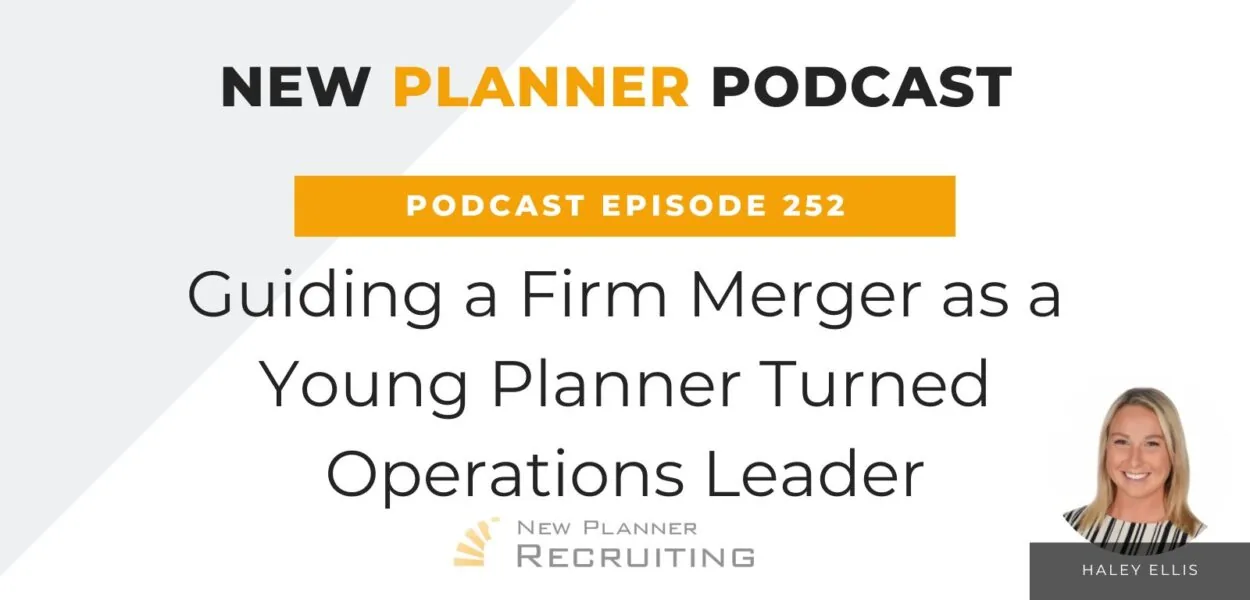
Haley Ellis is the Director of Operations at Allegiance Financial Group Advisory Services, and she joins the show today to share her transition into the financial planning profession. If you’re interested in navigating career moves with confidence or overcoming challenges as a young professional, this episode is for you!
Listen in as Haley shares how she discovered financial planning later in her college career and secured an internship that confirmed her passion for helping others. She also talks about her move across the country to start her first full-time role, the process of earning her licenses and completing CFP coursework, and how her responsibilities have evolved as her career has grown. You'll learn how Haley faced and overcame age discrimination and turned it into motivation for success.
What You'll Learn In Today's Episode:
- How Haley navigated challenges and opportunities during her career transition. (1:10)
- How she balanced work and education while advancing her career. (2:10)
- What it was like transitioning into a leadership role. (9:50)
- How Haley overcame age discrimination. (13:00)
- How she handled rejection and setbacks along the way. (16:00)
- What she and her firm use for business management. (16:10)
- How she defines her client niche and service offerings. (20:20)
- Words of wisdom for aspiring planners. (22:10)
Ideas Worth Sharing:
“If you would have told me seven years ago, when I was an undergrad, that I would end up living a few blocks off of a beach and being in the role that I am in now, I would have told you, you're crazy.” - Haley Ellis Share on X “I just fell in love with financial planning. Getting to see the work that she was doing, the sense of relief and peace of mind with her clients and making a difference in their lives just really tugged on my heartstrings.” - Haley… Share on X “I've just really thrived in this role that I truly didn't even know existed when I first got started in the industry.” - Haley Ellis Share on XResources In Today's Episode:
- Haley Ellis: LinkedIn
- EOS Worldwide
- Traction: Get a Grip on Your Business by Gino Wickman
- Finding your Path: The Roadmap from Student to Successful Financial Planner by Caleb Brown
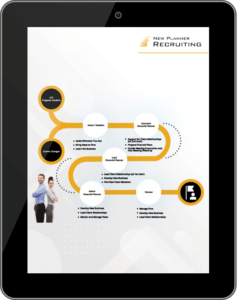 Download your free copy of the New Planner Career Roadmap! In this roadmap, you'll be guided through the details of various stages of your financial planner career, including position descriptions, licensing, skill and experience level requirements, and compensation ranges.
Get the Full Episode Transcript:

Read the Transcript Below:
Welcome to the New Planner Podcast, where it's all about helping you successfully enter the financial planning profession and accelerate your financial planning career. This podcast will help you understand the profession, become familiar with the various career paths available to you, and avoid the mistakes that limit your success. Join your host, Caleb Brown, to explore the human side of creating a successful planning career through interviews, personal experience, and insights from the trenches. Let's get started.
Caleb Brown: Welcome to 252nd episode of the New Planner podcast. This is Caleb Brown, your host. My guest today is Haley Ellis, who's the Director of Operations at Allegiance Financial Group Advisory Services. Haley joins the show today to share her transition into the financial planning profession. She shares how she found out about financial planning later in her college career, but was able to secure an internship that solidified her passion for making a difference in helping others.
She also discussed how she wanted to relocate to a different part of the country after graduation and how she found her first position in a new area, how she obtained the necessary licensing and CFP coursework, and how her role has shifted as her career has progressed. Also, be sure to stay tuned to the end to hear how she overcame age discrimination and used it as motivation. I hope you enjoy this episode with Haley Ellis.
Hi, Haley. Welcome to the New Planner Podcast.
Haley Ellis: Hi, Caleb. Thanks for having me.
Caleb Brown: Absolutely. I've been looking forward to this for a while, and there is a story here, so I just, I mean we're dying to know how did a mid-Westerner end up in Wilmington, North Carolina. So maybe why don't you just start us at the very beginning. How did you even get interested in financial planning?
Haley Ellis: Yeah, absolutely. It's funny to look back, if you would've told me seven years ago when I was an undergrad, that I would end up living a few blocks off of the beach and being in the role that I am in now, I would've told you you're crazy.
So, grew up in Michigan originally, went to a small D2 school. They didn't even have a financial planning program. I just studied corporate finance because I knew I wanted to work with numbers. But I also was really passionate about making a difference in people's lives. And so early on in my curriculum, I learned, I didn't really want to go the corporate finance route and help a million-dollar company make more millions.
I really wanted to work with people one-on-one and make an impact in their lives. And so my junior and senior year, I got the opportunity to intern with a local, independent financial advisor. And that's when I just fell in love with financial planning, just getting to see the work that she was doing, just the sense of relief and peace of mind with her clients and making a difference in their lives, just really tugged on my heartstrings, and I knew that this is what I wanted to do long term. And so after that, I joined FPA, the Financial Planning Association, as a senior. I knew I wanted to move somewhere south.
I love Michigan in the summertime, not so much in the winter. So was looking to move out of state, and that was kind of it. I struggled early on because all of my friends that were in the corporate finance and business school, they all had jobs upon graduation. Their internships turned into jobs.
Most of them were staying locally. And I actually graduated without a job, and that was really hard for me. I was an overachiever in school and so being the only one outta my friend group to not know exactly where my career path was leading was a little bit scary. And I think in the industry we still have some work to do in terms of connecting these entry-level financial planners with these smaller firms.
All the positions that I was interviewing for were more sales-based. I knew I didn't wanna do that. I'm not a sales-oriented person. I wanted to work with a small firm where I can make an impact, and I wanted to move. And so what I ended up doing was, one, speaking with you and going through the kind of recruiting process, which was awesome. Can't recommend it enough. And then also, I just ended up emailing my resume to a bunch of financial planning association chapters all across the south. Just told them a little bit about me, what I was looking for, and my local FPA chapter here in North Carolina ended up connecting me with my current firm and the rest is kind of history.
Caleb Brown: That is so cool. Yeah. And thanks for kind of the lockdown memory laying there, 'cause it's been a while. Hey, I did wanna go back. I mean, it sounded like the internship was really what, it just sort of puts you over the top and man, financial planning. How did you get the internship?
Haley Ellis: Yeah. Really great question. So through my school, my insurance planning class, my professor knew some financial planners. And so when I started to talk with him and let him know that this was kind of the path I was interested in, he actually connected me with her. And so I would say, yeah, whether you're at a financial planning school or not, if this is something that you're interested in, you have to put some work in and be proactive. So reach out to your professors. Reach out to your local firms. An entry-level role in this profession isn't necessarily one you're gonna find just uploading your resume on Indeed, like you have to put the work in and reach out. That's how you're gonna find the right fit for you.
Caleb Brown: Okay, so Wilmington was where the job was. Did you move there? You moved there first?
Haley Ellis: No, no. I moved for the role. Yep. So I graduated, I interviewed down here in June, and then ended up moving in early September to start.
Caleb Brown: Okay. So if the job would've been somewhere else in the south, you would've moved there?
Haley Ellis: Yeah. Yeah. If it was close to the water, I was ready to go. I'm an only child. My parents moved with me. We were ready to just be somewhere warm, so.
Caleb Brown: Really, your family moved down to North Carolina with you? Wow.
Haley Ellis: Sure did. They live like a mile away, so yeah, we're very close.
Caleb Brown: Okay. Alright. Well, talk to us about, so you got connected with Charlie, and then here you are showing up. You did not have a financial planning degree at that point, but you'd maybe passed some licensing exams, if I remember right. What?
Haley Ellis: Correct.
Caleb Brown: What happened next?
Haley Ellis: Yeah, so I, once I knew this was the profession I wanted to be in, like I said, I joined FPA and then I got the Series 7 and 66 study materials.
And so I started my senior year, studying for those exams. I took them over the summer, so I was kind of ready to go once I started in the fall with Charlie. And then I spent my first full year down here doing the CFP coursework, so unfortunately, I didn't do it during school, but I made up for it and did it right after.
If you're thinking about it, I highly encourage you to do it sooner rather than later, because once you're out of school mode, it's really tough to get back into it.
Caleb Brown: Yes. And I want you to talk a little about that a little further. I mean, here you are sort of showing up and if I remember right, Charlie had a smaller firm and there wasn't a lot of you at that point, and you probably were having to do a lot and had a lot on the plate…how did you stay interested and manage the time and just that's a lot going on to have to work full time and then in the evening go through a CFP program and then study for the exam. So how did you do that?
Haley Ellis: Yeah, it was not easy by any means. I think first of all, having a wonderful support system, both at the firm level, the support from leadership, letting you leave work an hour early or just understanding some days when you're bogged down, it's 'cause you're stressed, you have an exam coming up, but then also having your community around you, so family members and friends, and just really clearly communicating ahead of time with those people, your expectations. I had to sacrifice a lot that first year because I was working and studying. I couldn't go out during the weeknights and go to dinner with friends, I was at home studying.
And when we would go to the beach on the weekends, I'd have to get up early to take a practice exam before I could meet everybody out there. And so, it's not easy. It was definitely worth it, but just openly communicating with the people around you that this is your top priority for the next six months to the year, so you can really focus on what was important.
Caleb Brown: And I wanna go back to the 7 and 66. Did the company, did your new company, get you those materials or, and then how did you get registered to take the exam? 'Cause you have to be sponsored.
Haley Ellis: Yes. So I actually did it as an elective capstone my senior year. So I bought the materials myself because I wanted to be ready to do that. But our firm now sponsors all new employees that need to take that, so.
Caleb Brown: Got it. Okay. Alright. So you joined the firm, you got through the CFP. You are loving life in a beach community, Wilmington, North Carolina. How was the job? I mean, new college grad, I mean, I've talked about this before, my own career. Like I wasn't bringing a lot to the table when I showed up. Like didn't have clients, didn't have any experience. I mean, so how did you add value and build your confidence?
Haley Ellis: Yeah, really great question. It's about finding ways to add value to the firm, even with your lack of experience. And so when I came in, I was ready to be a sponge, eager to learn everything that the firm wanted to teach me.
But I also tried really early on to help share like process improvements, way to make the client experience better, taking time to go above and beyond and just if there's a question a client has, telling the advisor, “Oh, let me research that and get my findings back to you.” So there's a lot of ways that you can add value early on.
We've seen it with a lot of our new hires at our firm too, outside of the lack of experience or education, whether it's process improvements or just taking things off of the leader's plates, can make a big difference.
Caleb Brown: Maybe just walk us through what role you, the title, or whatever you guys called it, what role you started in.
Haley Ellis: So I started out as a financial planner, so just sitting in on client meetings, prepping for those meetings, taking notes, helping with the follow-through. We had a lot of 401k plans as well, so I was helping with the enrollment and participant questions around those. But I've taken a really unique career shift over the last few years.
So I was doing the financial planner work for like the first four years, and then our firm actually went through a merger and so we went from a team of four. We were merged with a firm up outside of DC and became quickly a team of eight. And when that happened, there kind of became this need for this leadership role to kind of oversee the financial cleaning division and just help streamline the client experience.
And at that time I was really excited about it because I was, I felt ready to take the next step in my career. I felt ready to take more of a leadership role. I had that good foundation under me. I had the CFP. We didn't really know at the firm level what that role was going to look like, but I just kind of dove in headfirst and we just kept open communication around it.
And so over the last three years, I've shifted actually, almost completely out of the financial planning and client-facing work. And I'm now on track transitioning to be the chief operating officer of the firm. And so right now I'm the director of operations. I've been doing that for the last year and a half and have really, again, like not doing any of the financial planning work anymore. I'm running our team, running our operations and helping ensure that we have a world-class client experience.
Caleb Brown: This is fabulous. I mean, here you are like seven years out of school. I mean, you have not been at this very long and like what you've been able to do. How did you learn all this leadership and this organization, this management, at such an early stage of your life and your career?
Haley Ellis: Yeah, it started for me when I was really young. I feel like I was a natural-born leader, just throughout school and just leading different organizations. But I feel like where I really learned and grew my leadership skills after college was being involved with the financial planning association, actually.
So I served on my local chapters board for five years, right when I got started and moved down here. I felt like I owed them something since they got me this amazing role that I am now in. And I've also served on the FPA Next Gen Leadership Committee for four years. And so being a part of those organizations allows you to not only give back to the profession, but really allows you to elevate yourself and work on those leadership skills outside of the day-to-day role of your firm.
Caleb Brown: Yeah. I mean, I can relate to that. My story's out there, but I can relate to that. That's similar where I've built my confidence and just dealing with people and managing committees and trying to get a bunch of unpaid volunteers that are busy to do what you want them to do, you have no real recourse over, I mean, it's challenging, but it's a good challenge and develops those skills.
So, okay, so you start a financial planner, then you're moving in. I mean, do you miss the client work, the CFP work?
Haley Ellis: It's a great question, and I struggled really hard with the transition early on. I thought long-term I would do 50% financial planning and 50% operations and team management. But honestly, once I got started in the role, within six to nine months, I was like, “Oh, no.” Like this is what I was meant to do. When you just feel like it's the right fit, and you just feel like you're jiving day to day. I just feel like my natural strengths are around process improvement and keeping everything organized, keeping everybody on the right path.
So I've just really thrived in this role that I truly didn't even know existed when I first got started in the industry. And so, to answer your question, no, I don't miss the financial planning work, and I still get to participate in it in some ways. And where I had that original passion for making a difference in people's lives and working with them directly and helping them manage their finances, I'm not doing that as much one-to-one with clients anymore, but in supporting the team and supporting our operations, I know our team is executing that and so I'm getting to truly do it on a bigger scale than I would just one-to-one working with clients.
Caleb Brown: Any age discrimination on that? I mean, how have you dealt with that? Like even if at the FPA level or in the being like, “Oh, Haley, come on, you're just brand new. What are you thinking? I'm not taking orders from you.” I mean, have you had to deal with that?
Haley Ellis: Oh yeah, absolutely. I mean, being young, being a woman in this industry, like it's no secret.
We see it with clients, we see it at leadership levels, but that one, within my team, no, I feel so grateful to have the amazing team that I've worked with. They've supported me a hundred percent from day one and two, it kind of fuel my fire. I'm passionate about getting other women in the industry, other minorities, letting everybody know that there's more than one career path within the profession as well.
Like I think when you get started in this career, you wanna get your CFP and you just think you're gonna become a lead advisor and that's really the only career path that's advertised or that you think of. But there are so many different avenues. You know it, you're in recruiting. Operations, marketing…some people just wanna be a service advisor. They don't wanna have to go out and get new clients, and all of those career paths can be very fulfilling, can be very profitable, and so it's really not a one-size-fits-all career journey.
Caleb Brown: All those career journeys, they're okay. I mean, for the longest time, I felt like the candidates that I'd interviewed were like, they felt like they had to say, “What, I wanna have my own firm,” or, “I wanna go get the business.”
But they really didn't wanna do that. But they just like felt like they needed to say that 'cause they were lacking confidence. Like, no, if you say, “I want to be…” ‘Cause what I tell the candidates, and you know this from dealing with, like, “Tell me exactly what you're looking for so I can find it for you. If you're not truthful, like I'm not gonna get you into a good fit.” So, it just, let's find something that matches with you. It's okay for you to say, “I want to be a paraplanner for the next 10 years. I wanna be a paraplanner forever.” “I wanna be a service advisor. I don't need to be the guy or the gal.” I'm cool with like doing this,” or “I'm cool…” That's totally fine. So I want people to be comfortable sharing all that.
The merger. Let's go back to that for a minute, because this is interesting. I mean, again, here you are sort of, you're kind of more on the integrator. It looks like you guys are using EOS or something. Because your title's an integrator merging these businesses. That's a big job. That's a big deal. How did all, how did that go for you?
Haley Ellis: Yeah, We're still, I feel like in the process of it. It's a big project, I think more than we could have ever imagined, but it's been so wonderful. Truthfully, it's day by day. I think running on EOS has completely changed the way that we run as a firm. It's helped keep us organized, helped us manage projects and just manage the workload in general. It's been so much change over the last three years, writing processes from scratch. We have hired four, soon to be six team members.
Just all the things that go into that, shifting roles and responsibilities amongst the team, and so just taking it day by day, staying on top of the projects and really prioritizing each quarter what's truly important to us has been very beneficial. And then also investing in coaching. We have two different coaching programs that we work with that have just helped us become more aligned both at the leadership level and the firm level, and helped us get through some of these bigger projects like hiring, like client segmentation, like marketing. And so, yeah, it's been a big journey, but it's been incredible.
Caleb Brown: And we may have some listeners that don't know what EOS is. Would you just explain that to them?
Haley Ellis: Absolutely. EOS is the entrepreneurial operating system, and so it is a set of tools that help small businesses run more efficiently. It's across all industries, so it's not just the financial planning profession, but it just gives you the framework and tools to run your business. So setting priorities each quarter, how often we meet, meeting one-on-one with team members for feedback and kind of performance reviews. And so if you haven't checked it out, I highly encourage you to do so. I can't even imagine how we would be operating now without it.
Caleb Brown: For the Gino Wickman, “Traction” and then “Rocket Fuel.”
So you can buy the Traction book and kind of go through all the EOS stuff. So, and to your point, I mean, that might be for a job seeker, might be a good investment. Get the stuff, fill out some of the, what they call the rocks and the tenure, all the, for the sheet, the worksheets that are in there.
And then you kinda show up to your first job and present that. I mean, there's not gonna be a lot of candidates that are doing that, so just maybe something to file away.
Haley Ellis: Definitely, yeah, we were lucky that a coach brought it to us, but yeah, I've fully have kind of led the implementation of it as the integrator of the firm and if somebody came to us and had some background knowledge on that or just the initiative to research something like that. It doesn't have to be EOS, but just something to make the firm better, we would love that.
Caleb Brown: How have you handled rejection or ups and downs and setbacks over your short career thus far?
Haley Ellis: Yeah, it's challenging, like I said, as a woman and as a young person, I've felt like I've really struggled early on with imposter syndrome, especially working with clients.
When you're new to the industry, it's like, how can I tell somebody that's double my age what they should be doing? And with that, I've learned, and even now in my role, it's okay to not have the answers. It's okay to tell somebody, “I need to do some research and get back to you,” or, “I need to talk with this person and develop a plan for that and get back to you.”
So I think for me, it's just been being completely honest, whether it's with clients, whether it's with my team members, whether it's in my personal life, is just communicating well and just being honest about where you're at. People are a lot kinder, I think, than we are to ourselves, and so you probably will get some good feedback and some support in that journey.
Caleb Brown: And this is not the answer that everybody wants, 'cause they want the shortcut. But confidence, a lot of times just comes with time in the industry and time in the seat and time on the job, not just for financial planners, for everybody.
Haley Ellis: Yeah.
Caleb Brown: And so, okay. Got it. So talk to us a little bit more about the business right now. So, I mean, is there a specific client niche or something you guys focus on? I think you gave us the number. Did you give us the number of team members? How big's your team right now?
Haley Ellis: So we are 10, soon to be 12 right now.
Caleb Brown: Okay. And then any specific type of client, niche, or service offering, or anything that might make you guys unique?
Haley Ellis: Yeah. Our niche is working with dentists. But it's funny when we advertise that or talk about it because probably like 20% of our clients are actually dentists. So we've identified them as a target market just for our marketing efforts. We do work with a lot of dentists. They need a lot of help. They're a really fun group to work with, but we're kind of all over the place in terms of clients that we serve. We serve a lot of younger clients, the DC area.
We have a lot of tech and lawyers and government workers, and so it's a little bit all over the place. So, which can be a challenge in terms of like streamlining the client experience, but we're working on it.
Caleb Brown: I mean, you've had a great career so far and really accomplished a lot. And I mean you, you're an experienced female CFP, which I've said lots of times on the show, is what everybody wants, so when all these recruiters and all these people have reached out trying to get you, why have you stayed at your current firm? I mean, you, and again, you're sort of bucking the trend. You joined a firm and you've been there for seven years, which is like the Gen Z, other Gen Zs are really gonna get upset with you, Hailey, you gotta stop this. So why have you stayed?
Haley Ellis: Yeah, it's a wonderful question. I just love the people that I work with and it hasn't always been easy, truthfully, like early on trying to figure out my long-term career path. I think a challenge that a lot of firm owners and lead advisors have is they're so deep in the client work, which is so important. They sometimes lose the capacity to mentor the team and develop career paths and check in with them. And so I think, as a younger planner or whatever role that you're in, it's really important for you to step up and advocate for yourself. And that's something that I did early on and I'm so glad that I did because I wouldn't be where I am without it.
But just being honest with the leadership team at your firm, letting them know what your strengths are, what you wanna learn, what conferences you wanna attend, ask for feedback on how to get better and what they think that you can improve on. Don't rely on them to come to you at your annual performance review and share the feedback and next steps.
Like bring that to them for what you want. When we went through this merger, I was the one that stepped up and said like, “I'm ready to take on more responsibility. What can that look like?” And so we didn't really know at first what that looked like. And it took a lot of meetings and time for us to figure out what my role long-term should really be within the firm.
And now that it's kind of evolved into that, it's been a tremendous fit. And so if I wasn't having those conversations early on, we might not have ever gotten to this point, but I'm so lucky to have a wonderful leadership team that wants to support me and help me grow and really helped me find my natural strengths and that fit within our firm.
Caleb Brown: Really amazing story. I mean, any final tips or words of wisdom before we close out?
Haley Ellis: Yeah. I would say, again, just know that you don't have to have all the answers. I think it's tough when you're a natural overachiever and you do well in school and you graduate and you just wanna change the world. You wanna make this huge impact, have this legacy, be known by everybody. And that takes time. You can't do that all within the first few years and where you start in the industry probably won't be where you end up.
Yeah. There's some people that say they're gonna start a firm and they do that and they're very successful. But that's what I thought I wanted to do. And a few years in I was like, “No way. I do not have that entrepreneurial spirit. Like that is not for me. I'm never going to do that. I'm not a risk taker like that.” So know that it's okay to pivot at any time. And again, just having those open and candid conversations with the people at your firm and in your life are gonna make the most impact. So don't be afraid to have those.
Caleb Brown: Haley, thanks so much for coming on the show.
Haley Ellis: Thanks for having me, Caleb.
Thanks for joining us for this episode of the New Planner Podcast. If you are ready to discover the top career paths for financial planners and see which track is best for you, we created a free guide to help you. Grab your copy of the Financial Planner Career Roadmap at newplannerrecruiting.com/roadmap. There, you'll also find more tools and resources all created to help you build a successful financial planning career. Tune back in next week for another episode, and until then, we are here to help you succeed.
Share the Love:
If you like the New Planner Podcast...
Never miss an episode by subscribing via Apple Podcasts, Spotify, Amazon Music, YouTube Music, or by RSS!



Leave a Reply