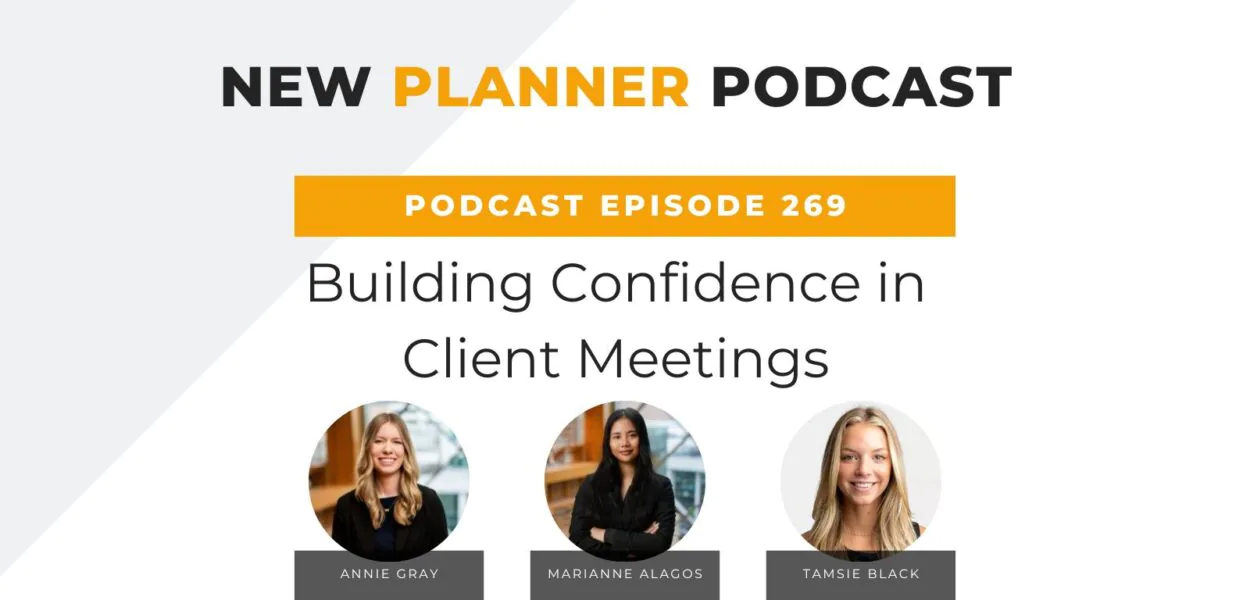
Tamsie Black, Annie Gray, and Marianne Alamos are recent graduates who have stepped into their first full-time financial planning roles at Wealthway Financial Advisors, and they join the show today to share their journeys into the profession. If you're interested in navigating the transition from student to professional, building confidence early, and preparing for the CFP exam, this episode is for you!
Listen in as Tamsie, Annie, and Marianne talk about how each of them discovered financial planning, why they chose it as a career, what excites them most about the profession, and what drew them to Wealthway. You'll hear about gaining early exposure to client meetings and building confidence, CFP study processes and exam goals, and managing the shift from college to full-time work. They also offer practical advice for new planners just starting out in the profession.
What You'll Learn In Today's Episode:
- How Annie discovered financial planning and what led her into the profession. (2:00)
- How Marianne found her path to financial planning and what influenced her career choice. (3:30)
- How Tamsie transitioned into financial planning and what shaped her decision. (6:05)
- Internship experiences and early career insights that helped shape their professional development. (9:10)
- Challenges they faced early on and the key lessons they learned. (24:15)
- How they navigated the transition from student to full-time professional. (43:25)
- Their future goals and long-term career aspirations. (45:40)
- Advice for new planners entering the profession. (46:10)
Ideas Worth Sharing:
“One of the professors who taught some of the financial planning classes came in to talk about financial planning, and it was just kind of like an aha moment for me.” - Annie Gray Share on X “I really value personal finance because I believe it gives you freedom in the future.” - Marianne Alagos Share on X “I knew that I would prefer working for a smaller firm and kind of having a big impact where I'm at.” - Tamsie Black Share on XResources In Today's Episode:
- Tamsie Black: LinkedIn
- Marianne Alagos: LinkedIn
- Annie Gray: LinkedIn
- Wealthway Financial Advisors
- New Planner Recruiting - Financial Planner Career Roadmap
- Finding your Path: The Roadmap from Student to Successful Financial Planner by Caleb Brown
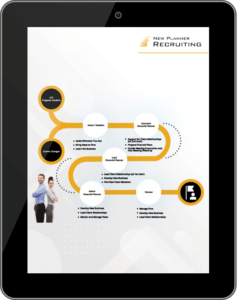 Download your free copy of the New Planner Career Roadmap! In this roadmap, you'll be guided through the details of various stages of your financial planner career, including position descriptions, licensing, skill and experience level requirements, and compensation ranges.
Get the Full Episode Transcript:

Read the Transcript Below:
Welcome to the New Planner Podcast, where it's all about helping you successfully enter the financial planning profession and accelerate your financial planning career. This podcast will help you understand the profession, become familiar with the various career paths available to you, and avoid the mistakes that limit your success. Join your host, Caleb Brown, to explore the human side of creating a successful planning career through interviews, personal experience, and insights from the trenches. Let's get started.
Caleb Brown: Welcome to the 269th episode of the New Planner Podcast. This is Caleb Brown, your host. My guest today are Tamsie Black, Annie Gray, and Marianne Alagos. All three have graduated from their undergraduate program in the last year and are in their first full-time financial planning roles at Wealthway Financial Advisors.
The trio joins the show today to share their story on how they learned financial planning, why they chose to pursue it as a career, what excites them about the profession and why they joined Wealthway. Annie shares her experiences of getting involved in client meetings and building her confidence early on.
And then listen in to Marianne and Tamsie share their study process for the CFP and their goals for passing the CFP exam. Stay tuned to the end to hear how they've all managed and handled the transition from student to professional and other tips for new planners. I hope you enjoy this episode with Tamsie, Annie, and Marianne.
Hi, Marianne. Hi, Tamsie. Hi, Annie. Welcome to the New Planner Podcast.
Annie Gray: Hi.
Tamsie Black: Hi.
Marianne Alagos: Hello.
Caleb Brown: First ladies, thank you so much for getting on here and, and joining us and donating your time to help the, the next gen of the financial planning profession. This is very important. I'm excited to talk with each of you and just see how the episode unfolds and exploring your story.
So, Annie, I wanna start with you 'cause you're the elder Stateswoman here. You, you have one year of one year in the business. So maybe if you would just go back and start like why did you go to Virginia Tech and get interested in financial planning?
Annie Gray: Yeah, so I actually started off my first two years at community college and then I transferred to Virginia Tech. I had some friends there, so I had visited and I just really liked it. So I transferred there, started as a junior and I was originally just a finance major. But then we had to take a careers in finance class. So I was in that class and we were learning about all the different ways you could choose your major.
And nothing was really speaking to me week after week until one of the professors who taught some of the financial planning classes came in to talk about financial planning. And it was just kind of like an aha moment where I was like, “Oh, wait, I actually might be interested in this.” And I didn't really know anything about financial planning, or I never really heard of it, so I just like talked to him after the class and then I kind of just decided to switch my major and see if I would like it, and then ended up turning out well.
Caleb Brown: Was that Professor Lineberry? Heck of a salesman. Was that, who was the professor?
Annie Gray: No, it was actually Professor Klock.
Caleb Brown: Oh, Derek Klock. Yeah. Okay. Alright. Who's since retired, but really helped build that program.
Annie Gray: Mm-hmm.
Caleb Brown: Fabulous. Okay, got it. So come, gonna come back to you for more on that. But let's go to Marianne on because you, and we're gonna get to Tamsie and you guys didn't go through a CFP program, so how did you get interested in financial planning, Marianne?
Marianne Alagos: Yeah, so University of Richmond, they only offer corporate finance, didn't really offer anything within personal finance.
And I think it was my last year, my senior year, that they offered a personal finance class, which I wanted to join, but they told me I couldn't, for some reason, and it was, I was okay with it. I was okay with it. I found out about financial planning because. I didn't have an internship my junior year. I studied at SMU, Singapore Management University, so I got back, I didn't have the chance to apply.
So my senior year I went to our career services, Mr. Keith Webb. I asked him for advice and said, like, these are the things I wanted to do. Our school didn't offer it, so he told me to reach out to one of our alum who, they work at Jenny. I think he's the vice president of the firm.
I spoke with him, spoke about the things that they do, and asked if I could intern for the year, which they agreed. I went there every Friday. And it was more so financial advisory. It wasn't really much planning, but it was a client calls to give them advice and they help them manage their assets. So that's when I found out that I really wanted to do financial advisory, financial planning, because it gives me a satisfaction to know that I have the capability to help someone with their financial decisions.
Caleb Brown: That's amazing. So you went to somebody in your school, in the career services, and then they connected you with an alumni. And then you called that person and then you actually asked them for an internship?
Marianne Alagos: Yes. Yes.
Caleb Brown: I love it.
Marianne Alagos: Well, originally, I asked to shadow. I emailed them. They got back to me. I told them, “Oh, like, so and so recommended that I reach out to you.” Emailed them. They got back to me. They asked me to–originally, I asked to shadow and they said, “Oh, come on in.” And then they were trying to get to know me and I asked if there's like, “If it's possible for me to intern, I'll do it for free.” Like I'm, “Oh, like my main goal is to learn and not more so about money. So like, it was more so for experience.” They said they couldn't do it. They, I couldn't do it for free, so they were like, “We'll pay you to come intern for us and you can come here every Friday.” And I said, “Okay. That's great. That's wonderful.”
Caleb Brown: Great, great confidence. I mean, that's really cool. And look, it worked out for you.
Marianne Alagos: It did, it did.
Caleb Brown: Okay. Tamsie, how did you get started? Because you're, again, not from a CFP program, so how did this pop up on your radar?
Tamsie Black: Yeah, so kind of similar to Annie. I was originally in accounting, so I was in a different, you know, but I had my first finance class, like freshman or sophomore year, I think. And my professor at the time, Professor Rodriguez, when I was at the University of Louisiana Monroe, he was my teacher in finance. And I was like, wait, this is so much better than accounting, in my opinion.
So I actually kind of just went to his office one day and kind of spoke to him about maybe switching to finance as my major, and I was asking him about what career opportunities they have in finance and kind of what jobs I could get with that. So he told me about a bunch of different things, and I guess financial advising just stood out to me as something that seemed interesting because I do love, you know, working with numbers and doing all of that, but I was like, I like people too. So he told me about financial advising and it just kind of stuck with me and I switched my major like that week and kind of just went the corporate finance route.
Caleb Brown: Got it. Because that was all it was offered. But your plan has been to go into personal financial planning, right? Is that right?
Tamsie Black: Yes, that's right. Because we, well, when I was at Louisiana Monroe, they did have a finance only, but they didn't have financial planning, kind of similar to Marianne. But I wanted to know what I could do with that degree, and so I kind of knew that that might be something that interested me and so I kind of had my sights on it, I guess.
Caleb Brown: Okay. And then you had, if I remember right, you were a sports career. You had a sports career. Is that why you trained schools?
Tamsie Black: Yeah, so I played beach volleyball all four years in college, and I was at Louisiana Monroe, three years playing. And then I transferred to UNC Wilmington for my last year just to be closer to home.
Caleb Brown: So, no financial planning internship, but you had the volleyball stuff going on. Were you also working during your college career?
Tamsie Black: I would work during the summer. So like, during summer break, I would have just your typical summer job. I worked at a gym. I've been a lifeguard.
Caleb Brown: Sure.
Tamsie Black: Just kind of the summer gigs that they have out there. But in school, like you didn't really have much time to get a job, like while I am playing, because you have to practice.
Caleb Brown: It's a lot on the plate.
Tamsie Black: Yeah. Yeah. It's like three hours a day. It would be very hard to do that.
Caleb Brown: Alright, let's, thanks for sharing that. Annie, let's come back to you. So when you were graduating and, 'cause I think you had done an internship as well, is that right? Talk to us about your internship, how you got it and what you did, and maybe how that's helped you in your current position.
Annie Gray: Yeah, so my internship was in the same area two summers ago and I got it from, so Jesse Lineberry. He's been super helpful and he'll send out an email every week, lists of internships and jobs.
So I got it from that email. I just knew where I wanted to be, so I looked at those places. I applied, interviewed, and then got the internship and it definitely helped me see like what kind of job I would have in the future. I got to shadow a lot of people who are doing a lot of similar things to what I'm doing now. So I think it just kind of gave me some like real world insight into what my job would actually look like.
Caleb Brown: So I'm hearing, I mean, it solidified that this is what you wanted to do.
Annie Gray: Yes, definitely.
Caleb Brown: And then what you, when he sent the email out, you said, was it a location that was interesting or was it a job title or was it– I don't think I picked up on that. What made you apply to that one?
Annie Gray: Well, I was looking in like Virginia Beach area, 'cause my boyfriend's in the Navy, so he was here. So I wanted to come in this area, but I applied to a few different ones and they stood out to me. They just seemed like the most, I don't know. I just like their personality the most.
Caleb Brown: Gotcha. Okay. Marianne, let's come to you. So you had the job shadowing slash internship. Just talk, I mean, what were you able to do there? I mean, I know you were doing a lot of shadowing, but were you able to kind of roll your sleeves up and get in and, and see some of the nuts and bolts?
Marianne Alagos: Well, sort of like the first few weeks I had to write, like send birthday cards to write their addresses. And then it got more technical later on. They assigned me task projects, to do cleanup on Excel spreadsheet and more so they, like, they showed me how to buy, sell stocks, transaction and I sometimes, like I sat with the vice president, to listen to phone calls and how he gives advice to clients.
Caleb Brown: Mm-hmm. Okay. And then maybe talk about how that experience, I mean, how did you know what you were looking for when you graduated from University of Richmond?
Marianne Alagos: Well, initially, like when I sat in my corporate finance classes, I knew I wasn't as interested in it, only because I was more so working for the corporation, if I were to do corporate finance, and I love connection, I love being able to connect with people. Not really related to my internship, but I would often, I really value personal finance because I believe it gives you freedom in the future. So oftentimes I give my friends unsolicited advice on like where to invest their money, how they should allocate it, and now that I've gotten a career in finance, I actually handle their finances and make sure that it's in the right places. It gives me–
Caleb Brown: Wow.
Marianne Alagos: Yeah. I just wanna be a better friend and knowing that I have the knowledge where I can help them secure their future is very important to me. And so that one day, like for instance, “Oh, let's go to a different country.” They'll have the finance to do so because I help them get there.
Caleb Brown: You're everybody's best friend. Man, I wish I would've had someone like you when I was growing up. That's awesome.
Marianne Alagos: Yeah. But I have grown four friends, so that's like four people that I talk to and I try to like give them advice as much as I can, given that they all have jobs now. I tell them like, at least get the 401k match with your employer, save so and so this month of expenses, so you have an emergency fund. And once you reach that you can just maximize your Roth, or once you maximize that, put in a brokerage account.
Caleb Brown: Tamsie, let's come to you. I mean, again, no real internship, no real personal financial planning degree, but how did you know that you wanted to join? Well, I mean, how did you know what kind of firm you wanted to join? I mean, you've got several options. Like you could have gone a big wirehouse, you could have gone the insurance company route.
But you ended up at a small RIA, I mean, that's interesting to me. I mean, our listeners are curious to know how you were able to figure out that's the firm you wanted to join.
Tamsie Black: Yeah. Well, my senior year, I would say I kind of knew that I would prefer working for a smaller firm and kind of having like a big impact where I'm at, you know, with working closely with a team. And I guess that kind of just spoke to me because all my life I've been a part of a team and I just felt like taking a RIA like smaller firm would be the approach that I would prefer, because I like that team collaboration, like being able to work really closely with the people around you and I didn't just wanna be someone kind of in the back office, you know, just kind of doing my work. I wanted to kind of have a bigger impact than that, if that makes sense.
Caleb Brown: Okay. And maybe just talk about the last five or so months that you've been there. What have you been doing?
Tamsie Black: So, a lot of what we've been doing is just assisting our lead advisor, which is Khalil. So I will sit in on meetings, take meeting notes, I'll do the follow up actions, sending emails. I talk to some clients on the phone. So that's a big part of it. And then also just helping prep those meetings, helping with the planning. Just a lot of assisting.
And then we've also been doing a little bit of trading as well for our clients. So we do that every day. So yeah, I guess the big thing is just assisting, helping out, taking time off of our advisor's plate and helping out in that way.
Caleb Brown: And what's been the most fun part about this since you've been there?
Tamsie Black: I would say that my favorite part is definitely sitting in on meetings. I like being able to, 'cause whenever you're planning for these meetings, you're reading about these clients, you're learning about their life, their situation. And then when you're in the meeting, you finally get to put a face to the name and kind of see them and meet them. And it's just a lot of fun just to kind of see it all come together. And I just really like that aspect of it.
Caleb Brown: That's awesome. Marianne, same question. What have you been doing since you've been at Wealthway and what's your most favorite part?
Marianne Alagos: Everything that Tamsie said. And we also have been given speaking roles when we meet with clients as well. So that has been fun. We like slowly and slowly, Khalil's preparing us to the point where a year from now we'll be presenting to the clients ourself.
Caleb Brown: Nice.
Marianne Alagos: Yeah. So that has been really fun. And my favorite part would be the collaboration. So oftentimes I would work with Annie or Tamsie and we’d work, we'll work on a project together to prepare for our clients, and also, like, just like what Tamsie said, like meeting the clients, getting to know them and a story, actually, our lead advisor wasn't there for one meeting because he was off. He went to, yeah, he had a vacation. So it was just me, Kevin, and Tamsie for the presentation. I was nervous because I did a little bit of the presentation to one of our biggest client, but then. It made me really happy because after the presentation, he called twice to say that he was pleased with the presentation. He was really happy.
Caleb Brown: This is the client, the client that you presented to?
Marianne Alagos: Yes, yes. He called me and then he called again twice and I told our client, yeah, I was really nervous. Because it was actually like it was our first time presenting, like the Monte Carlo and just their projection. But it felt really good to have made the clients happy afterwards, for them to even call us and say like, “You did a great job.”
Caleb Brown: So rewarding and fulfilling, isn't it?
Marianne Alagos: It was, it was so rewarding, fulfilling. This is one of the reason why I wanted to join financial planning, because it gives me the satisfaction to have known that I've helped other people with our advice.
Caleb Brown: I want to go back to the speaking roles too. I mean, just maybe talk a little bit more about like, what does that look like? Like there's an agenda or something, and then it's like, “Okay, Marianne, Tamsie, Annie, you're gonna take this bullet point or this bullet point…” Somebody else is gonna take–is that kinda the way? Can you, I mean, Marianne, feel free, or anybody else that wants to chime in, just maybe talk a little bit about that.
Marianne Alagos: It's like a whole system where I'd be the advisor one to advisor one. Kevin and Khalil will be in the meeting. So Khalil will take the lead of the meeting, and before the meeting, he'd tell us, “Oh, you're in charge of speaking about the balance sheet, cash flow beneficiary.” Beforehand, we'll prepare for it, but mostly it's the advisor one that would speak with the lead advisor. But if Kevin is not in the meeting, it would be the advisor one, and the advisor two, and Khalil.
Caleb Brown: I was just, so Kevin and Khalil, they're your senior advisors?
Marianne Alagos: Yes.
Caleb Brown: And you guys are supporting them, so it's just working out beforehand what section you're gonna take to, to build the confidence.
Marianne Alagos: Yes, yes. Slowly. Khalil's plan. Khalil has been helping us gain confidence. So we started off with balance sheet and beneficiary, and then scheduling, and now he's slowly introducing us to cash flow, how to talk about it to our client. And in the future, he wants us to talk about tax report to our clients, just building us up, up until we can present it on our own.
Caleb Brown: And you feel like that's going well versus just busting right in and just going forward guns a blazing and doing your own thing.
Marianne Alagos: Yes. Yes. I think it has been going well. I'm really grateful for Kevin and Khalil. I think they're both great mentors, especially Khalil. He's worked with us ever since we started.
He's very patient with us. And they understand that at times like this, because we're new, we will make mistakes. And they often assure us that it's okay to make mistakes as long as you learn from it 'cause it's part of the learning process.
Caleb Brown: That’s great. Annie, talk to us a little bit. I mean, you're a little bit ahead of the, I mean, this is a cohort, but you're a little bit ahead. So how is your role different, if at all, from Marianne and Tamsie?
Annie Gray: I'd say I have a little bit more of a speaking role in the meetings than they do at this point, but they're catching up quick, so they're really just getting thrown into it, which I think is great, but I probably have a little bit more of a speaking role. But other than that, we're doing the same things. It's really nice to work with them.
Caleb Brown: And then the most favorite part of the profession so far for you.
Annie Gray: I would have to agree with Tamsie, definitely meeting the clients. One of the things that we do before every meeting is we go back and read all the past meeting notes, like back to 2016 and we take notes on those.
Caleb Brown: You take notes on the pre hour meeting notes. I love that.
Annie Gray: Yeah. Yeah. We really get to see the client's stories, so then it's really great to actually meet them in person and I've just been in some really, really great meetings, especially with people who are about to retire. And we've kind of seen them through like their working years and now they're like finally hitting that goal of retiring and just being able to help them figure out what they wanna do in retirement and how much they can spend. And we've had just some great meetings where people were just really like in shock about, wow, they actually made it this far.
Caleb Brown: It seems like the firm, I mean for a small RIA firm that there's a lot of thought and sort of diligent process for the training and onboarding of you guys. I mean, is that, that's what I'm hearing?
Annie Gray: Definitely, definitely. That was one of the reasons why I picked Wealthway. It really seemed like the place where I would be able to grow the most and where they kind of like had a path for me.
Caleb Brown: Wow, that's amazing. So we're recording this on November 19th. So, you have something that you shared with us, an awesome career announcement, before we came on the air. You recently took the CFP exam. How'd that go?
Annie Gray: So yeah, I took the CFP exam and I passed. So, very happy about that.
Caleb Brown: Congrats. Tough exam. Congratulations.
Annie Gray: Thank you.
Caleb Brown: And maybe just talk, I mean, for our listeners, like what, why didn't you take it sooner? How did you pass it? How much time did you spend? Just maybe comment on those.
Annie Gray: Yeah, so I graduated back in December 2024, so I just kind of wanted to have a break after graduating, a break from studying. So, and just kind of like be able to focus on work and figuring out everything I was doing there first before I started studying. But I took the Dalton review and I started studying at the beginning of August, and I went through that program.
I think it was really helpful, had a good structure and I thought you were able to follow. So I think that's definitely why I passed.
Caleb Brown: Did you feel, I mean, how were you feeling when you went into the exam? Were you feeling like, “Hey, I've got this,” or, “Man, I don't know a lot of material here. I'm still a little shaky on…” That's how I felt.
Annie Gray: Yeah. I felt like I was kind of going back and forth. Like one day I would feel really ready and then another day I'd be like, “Wow, this is a lot of stuff to know. I don't know how I feel,” but and even while I was taking the exam, I was like kind of doubting myself a little bit, but ultimately it did turn out well. So that was good.
Caleb Brown: Most challenging part of your year on the job so far in your career. And then we're gonna go to Tamsie and Marianne for the same question. Most challenging, difficult part.
Annie Gray: I would say probably either between learning eMoney, just 'cause there's, you know, a lot you can do in eMoney and we have like our, We have, I don't know, Khalil, he knows the ins and outs of it and sometimes it's just, especially at the beginning, it was kind of like hard to understand until you like really dive into it and start doing things on your own. So that was–
Caleb Brown: Powerful program, right? I mean, very powerful.
Caleb Brown: Yeah.
Annie Gray: Yes, yes. Very helpful. And then also I'd say the speaking roles in the meetings, those can definitely be challenging, especially at first when you're just trying to remember everything that you're supposed to say and you're just kind of focused on that, I think, and like adding new things. But I really like that we've just started off small and then we've been building on those smaller roles into, and they're turning into bigger speaking roles. I think it's way better than just getting thrown into it.
Caleb Brown: Love it. Tamsie, what about you? Most challenging, difficult part of your tenure in the career so far?
Tamsie Black: I would say probably since I'm so new, I think one of the most challenging things for me has just been learning all of our processes. There's a lot of steps to everything that we're doing.
You have to remember a lot of things to do. You know, after a meeting there's a lot of follow-up to do, a lot of little things that need to be done. So just remembering all of that and being able to put it all together has been pretty challenging. I mean, slowly but surely, it's getting a lot easier. But yeah, there's just a lot of steps and processes to what we are doing, so that's been hard to kind of remember all of that.
Caleb Brown: I mean, it seems like you're doing great. I mean, I'm just wondering, like, was there a little bit of a hurdle you had to overcome since you didn't have the internship or you didn't have the degree, kinda like Annie and Marianne. I mean, it seems like you're holding your own, I mean, what, what steps did you take to try to catch up if you indeed needed to?
Tamsie Black: Well, one thing that is difficult is kind of learning all of the technical. skills of everything. You know, there's a lot of new stuff that's coming at me, but you know, Kevin and Khalil, they're always saying the technical, that will come with time. Like you're gonna learn it. And so that's really comforting to know, but also taking initiative to kind of look stuff up that I don't fully understand on my own time, just to kind of know what's going on with people's situation and the nuances there.
So yeah, the technical skills are pretty difficult 'cause there's so many things, so many different things. But I'm learning it. So, I would say just taking that initiative to try to teach yourself and just be a sponge.
Caleb Brown: Got it. Marianne, most challenging, difficult part.
Marianne Alagos: I would say, aside from the speaking role, because just like Annie said, sometimes we're focused on trying to memorize what we say, I would say navigating eMoney, because we're at this point right now where we can update the balance sheet, the numbers, because they sent us statements.
But after that, like what can we do? What kind of scenarios can we make to where it could add value to our clients? So thinking about like adding value to our clients when we do meet with them, like scenarios that could help them enhance their life. So that's, I think, is the most difficult for me right now.
Caleb Brown: And I just, I mean, I wanna, the speaking part, I mean, this is really cool because not all firms do this. They just go in there with their associate planner and they're just like, “Are you gonna say something? Go ahead and talk,” like, I don't know what to say. You know, it's just, it's 'cause I kind of experienced that a little bit earlier in my career.
I mean, just the stakes are kind of high. I mean, it's like you guys alluded to sort of the nervousness. I mean, maybe just talk and maybe you already shared this, but I think it's worth exploring further, just how you guys were able to overcome. I mean, here's somebody that you've never met. They've got lots of money, they're a lot older than you. And you're walking them through their cash flow or their balance sheet or their investments. I mean, how did you get through that?
Tamsie Black: I would say that learning to speak during the meetings, it is very nerve-racking, but before these meetings, we know exactly what we're gonna be going over.
So if it's the balance sheet, we'll practice with Khalil and kind of say it out loud, kind of know what we're gonna say. And then also being able to practice that with Annie and Marianne before the meeting. So we do like prepare for it and kind of walk through like what we're gonna be saying and like being able to do it multiple times before actually saying it to a client in the meeting.
Marianne Alagos: And to add on to what Tamsie said, we know that because Kevin and Khalil are in the room, they will always have our back. So we have the, as like, if we were to say something, they'll always be there to have our back so that that gives us confidence.
Caleb Brown: Well, that's good, 'cause some people could say, “Hey, that makes me more nervous. I got senior people in there. I really, I better not screw this up.” Is there a two-way street, like for feedback, like, “Hey, you did this really well,” but did you notice like the client kind of like, do they ever give you that type of feedback?
Marianne Alagos: Yes. They do it after every meeting and then we give them feedback as well. Like, for instance, when, like my example for me was when I was reading the balance sheet, because Khalil speaks very polished and eloquent. So we try to imitate him, but it's hard. So when we do present it to the client, we sound like robots, you know, like we’re memorizing things.
So I would, with Kevin in the room, I spoke with Khalil and said, like, “It'd be easier if I say the balance sheet first and you can correct me, rather than you saying it first. And I have to try to memorize what you're saying, so like, I'm using the same language.” And they said, “Yes, that's perfect. That's fine.”
They went on with our feedback and ever since, I've been saying the balance sheet first before he says anything. He'd correct me if there's anything else I need to add or say, and it's been working out really well.
Caleb Brown: I mean, and I know some of the firm owners that are listening to this are like, “Golly, this is like Khalil and Kevin are having to spend a lot of time with you guys.”
Like why do you think they hired three pretty brand new people versus just hiring three experienced people that have already presented balance sheets and already know what they're doing? Annie, you wanna start with that one?
Annie Gray: Yeah. I think especially when I was interviewing with them, they really seemed like they wanted to mentor people and, you know, kind of create that relationship and have people that feel the same way about financial planning as them.
So, they can really shape us since we're new. Like we don't know much, but they can really be the one to like, teach us and teach us, teach us like the Wealthway way. So I think Khalil also, he likes teaching, so I think that was something that influenced them to wanna hire new people as well.
Caleb Brown: Thank you. Marianne, or anybody. And some of you've alluded to this like, “Hey, our job right now is to sort of assist Khalil and Kevin take stuff off their plates.” But, how else do you think you've been able to add value over your, what I'm gonna call, a shorter tenure in the firm?
Tamsie Black: I will say that, that's like a good question. And right now we're trying to add value as much as we can and really help them. But with our limited experience, I think our biggest goal right now is to really learn and grow, like they're putting time into us so that one day we can be where they are and be able to add value in that way.
So right now we're just trying to learn, help them where we can. And by hiring new people, they're able to shape us, like Annie said, and grow us into that financial advisor that they, that we want to be. And so I think that's kind of their main goal, is just putting all of this time into us so that one day we can repay that and add that value.
Annie Gray: I think we're really trying to grow as a firm. So I think that's gonna be a way that we're able to add value once we're more up to speed and can kind of take things on our own more. We'll be able to bring in more clients and grow.
Caleb Brown: Yeah, I mean, the other side of the coin of that is they hire someone experienced, well, they don't know how to do it the Wealthway way.
They're gonna have to unwind all that. And then get it, build it back up. Just, I mean, Annie, you mentioned that's what they do in the military, right? They build, they break 'em down and build 'em like the way they want to, and then, like quote unquote, brainwash the person into doing it this way. So there's both sides of that coin.
Marianne, did you have something you wanted to add to that as well on the value-add piece?
Marianne Alagos: Yeah, it was related to what you were saying, how it's easier to train younger, like fresh out of college, because they don't really have experience like from other firms on how they do things. So to be trained to do something, I don't know how to word this, but essentially because we have no experience, it's easier for us to say, “Oh, this is the Wealthway…”
Caleb Brown: Clean slate.
Marianne Alagos: Yeah, clean slate. This is how we do things at Wealthway. So it's much easier for us to adapt and train us.
Caleb Brown: Love it. Love it. Marianne, let's, I want you and Tamsie to talk about this one. I mean, like what getting the CFP or, I mean, what is the next step for you guys? I mean, I know you've just barely been there, but what are you working on right now or what are you pursuing now?
Marianne Alagos: Yes. So, actually, when we signed the contract with Wealthway, there was like a path for us, and the next step would be to get our CFP. Right now, Tamsie and I are enrolled in a class where we're studying the courses. And for me personally, I'm hoping to take the exam next November.
Caleb Brown: Okay. So you're enrolled in the CFP program right now?
Marianne Alagos: Yes.
Caleb Brown: So, that's quite a bit on the, I mean, I want to hear from Tamsie too, but like, okay, you're doing financial planning all day long at work, then you're going home and doing it in the evening or online or something. Is that the way it works?
Marianne Alagos: Yes. I'm studying online. So the habit I've built is after work, I go straight to Starbucks until it closes and study, and then repeat.
Caleb Brown: Quite the commitment. Tamsie, what about you? What's your game plan or your process?
Tamsie Black: I am also enrolled in the program right now. So, taking the courses, we go to work and we do our job. And then after, we do go home and study. And it is a lot and it's a lot of commitment, but it's gonna be worth it.
And I also think that right now, during work, we do have time sometimes to work on those courses during office hours. So we're able to work on that sometimes if we don't have much going on on our plate. So pretty much like I was saying, like our job is to learn right now and it's a lot, but it's good.
Caleb Brown: And it's, I mean, my sense is you going through the coursework while doing the daily, I mean this is helping you add value. I mean, one of the things I thought you guys said was cool. Like, I think it was Annie said, we go back and look at the meeting notes all the way from like, you know, 10 years ago.
Well, I mean, just think how powerful that is when you go into the client meetings and you've been there on the job for six months, but you know the Smiths history or the Browns or the Wilsons or whoever it is for the last 10 years. And you start talking and they're like, “Man,” they're like, “Hey, you know us pretty well. You just started that.” The clients love that. And that's where they're like, “Man, I love the fact that these ladies are my planners. I mean, they know me and I don't, I've never even met them.” That's powerful, isn't it?
Annie Gray: Yes, definitely. I've even had, like recently in a client meeting, I like brought up something from the past when I was doing my role, my speaking role, and the client was like, “Oh, wow, like you have a good memory,” or, “You're taking good notes.” And I was like, yep. It was the notes, like they were impressed by that.
Caleb Brown: That's really good. And maybe Anne, if you would, and I want to go to the other two in a minute, just, and you guys have alluded to this through the whole podcast episode here, but how impactful. And how beneficial has this been for you guys all to kind of start at the same time?
You're all sort of this, you know, same age, same career stage. How has that helped you guys in the culture and the just the camaraderie and then just the learning and can you just talk about that for a minute?
Annie Gray: Yeah, definitely. I think it's been really great, especially, I was there for a few months before they were hired and it's definitely, it was like I was the only one doing my job, and it was great to work with Khalil, but it's also really nice to work with someone who also like, doesn't know everything.
So we can kind of work off of each other and like sometimes they'll think of something that I didn't think of, or they'll have questions and I'll be able to answer their questions. So it's just really been great to get to know them and work with them every day.
Caleb Brown: Tamsie, what about you? How has this group helped you?
Tamsie Black: Yeah, so having this group has been really, really impactful and helpful as I'm learning because instead of just having to go to Khalil and Kevin for every little question I have, I'm able to ask Marianne or Annie. And like Annie said, we're able to work through things together and just kind of go back and forth with ideas and it just makes learning it all that much easier. And I love it. So, yeah.
Caleb Brown: Comradery, but maybe just a little small amount of friendly competition in there, maybe buried somewhere. Is that what–
Tamsie Black: Yeah, there's definitely like friendly competition there. It also helps you having two other people who are new. It helps you kind of stay motivated and kind of strive to be as good as you can be at your job. And so having Annie and Marianne helps with that friendly competition for sure. Yeah.
Caleb Brown: I mean, the faster that you guys can get developed, the faster you can take on clients, the faster the firm can grow. And from what I'm hearing, it doesn't seem like, I mean, no one's really holding you back, it's just how quickly can you get there and be ready to take on the clients?
Marianne, what about you? This group, I think you started off the episode by talking a little bit about it, but maybe just any additional thoughts.
Marianne Alagos: Yeah, I love this group. They've been really, really helpful with practicing the balance sheet. When Annie passed the exam, I would ask her for advice about the CFP and sometimes I would like, “Test me, Annie.” I was studying, like, “Test me about this topic.” And she'll ask me questions and I'll tell her to answer. That has been really fun. But they've been both really helpful when I have questions, planning questions, any questions in general. So I really do enjoy working with them.
So far, I haven't felt the friendly competition because there wasn't much to compete with because we're all on the same boat, we're all learning, but I really enjoy working with them, and I wouldn't have it, like, I wouldn't wanna have it any other way.
Caleb Brown: Friendly motivation. Maybe that's the better word. Tamsie touched on that. Yeah. Alright, Marianne, let's stay with you for a minute as we're winding down here, and this has been so fun and I'm just glad to be able to spend a few minutes with you guys. Any tips or takeaways, any words of wisdom that you'd like to leave the new planner audience with?
Marianne Alagos: Yeah, so in this line of work, my advice would be to focus on building relationship with people, with clients, because anyone can learn the technicals, but it's really hard to earn someone else's trust. And in addition to that, practice what you say, so build healthy like financial habits. Stay curious at all times and learn.
Caleb Brown: Those are great. You may have taken everybody else's answers. So Annie, we'll go to you and then we'll finish out with.
Annie Gray: Sure. I'd say I would agree with everything Marianne said, but also just like being super organized at work is helpful and taking notes, not just on like the clients, but also on all the processes that you're learning is really helpful to reference, 'cause you don't wanna be, you don't wanna like ask a question, get the answer, and then forget it and have to ask again. So I think just trying to keep your own personal notes.
Caleb Brown: Tamsie?
Tamsie Black: I would say that what Annie and Marianne said is definitely very important. While you're working and learning it's very important to really stay as organized as you possibly can, and also just make sure that you're learning like and just learning where you can and making sure to ask questions when you have questions. That's very important. Just staying on top of everything.
Caleb Brown: Got it. And maybe just talk a little bit, if you will. I mean, going and you had a lot going on. You’re college, collegiate athlete, you had the schoolwork, but the student to professional. I mean, that's still a transition. I mean, how have you guys, I mean, it sounds like all three of you have negotiated it pretty well, but that's still a big transition. I remember like when I, my first semester, that like I wasn't as, I'm like, oh yeah, like, everybody else is going off for somewhere from spring break.
“Oh, nope. I'll be at work. There's no spring break.” Like, just little things like that. How have you guys made that transition and, and to like taking the student hat off, student athlete hat off, or student hat off and putting that professional hat on. I know I heard organization, I heard asking question, curious, but is there anything else there that might be useful?
Tamsie Black: I would say that whenever you are going from being a student to a work environment, it is a big transition. It's very different. You know, you're going to an office every single day and you're there until 5:00, 5:30. And for me, like that was very different because when I was a student athlete, I was going to class and then I would have practice outside every single day, but it was kind of not a super difficult adjustment for me because just make sure that outside of work you are staying active and doing stuff that you enjoy doing and just prioritizing that when you can is very important. So, yeah.
Marianne Alagos: Yeah, for me, I don't believe it was much of a transition. I actually prefer this than going to school, to be honest.
Because while I was at school, I did have four jobs in college. So, like I wake up from 6:00 AM, sleep at 12:00 AM and that has been like the routine for me. So this was much, this is much better than going to classes and doing homework for my class.
Annie Gray: I would kind of agree with Tamsie, just, it's kind of nice being in a working environment where when you go home from work, you don't really have to do anything else. So you can just really have time to do the things that you wanna do and have that work-life balance so that you can be focused and happy when you are at work.
Caleb Brown: Guys, this is awesome. This has been so fun. I'm glad you guys are all thriving and it just makes me feel really good, and I think others that listen to this about the future of the profession.
So, I know I said last question like three questions ago, but is there any final comments or anything you guys would like to share before we close it out?
Marianne Alagos: Well, I just wanna say that I'm thankful to Kevin for giving us this opportunity and for taking risk on three new graduates, and we hope to help, and help him expand the company in the future.
Caleb Brown: Thanks so much for coming on the show, guys.
Tamsie Black: Thank you.
Marianne Alagos: Thank you.
Annie Gray: Thanks for having us.
Thanks for joining us for this episode of the New Planner Podcast. If you are ready to discover the top career paths for financial planners and see which track is best for you, we created a free guide to help you. Grab your copy of the Financial Planner Career Roadmap at newplannerrecruiting.com/roadmap. There, you'll also find more tools and resources all created to help you build a successful financial planning career. Tune back in next week for another episode, and until then, we are here to help you succeed.
Share the Love:
If you like the New Planner Podcast...
Never miss an episode by subscribing via Apple Podcasts, Spotify, Amazon Music, YouTube Music, or by RSS!



Leave a Reply