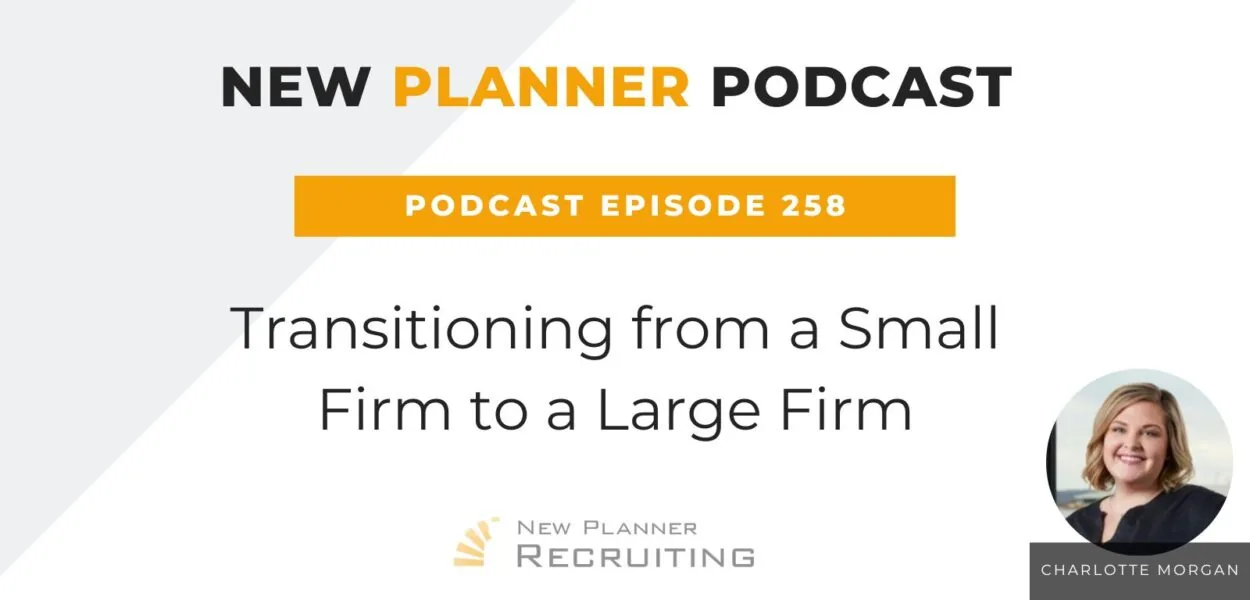
Charlotte Morgan is a financial planner at Creative Planning, and she joins the show today to share her career journey from college student to successful practitioner. If you're interested in navigating early career uncertainty, taking a break and re-entering the profession with confidence, or understanding what it’s like to experience an acquisition from the inside, this episode is for you!
Listen in as Charlotte shares how she began college planning for a career in accounting or finance, but ultimately discovered financial planning through a family friend. You'll hear how she stepped away after a few years (and later returned by joining her second firm), what it was like when her firm was acquired by a large RIA aggregator, and more.
What You'll Learn In Today's Episode:
- How Charlotte’s family influenced her early career decisions and helped shape her professional direction. (3:00)
- How her first internship led to early career success in financial planning. (5:30)
- What her transition into a full-time role was like and the growth she experienced early in her career. (8:00)
- Why she decided to explore new opportunities and to take a pause from financial planning. (9:40)
- The benefits she has seen from joining Creative Planning and working at a large firm. (14:00)
- The challenges of navigating that transition and how it contributed to Charlotte’s continued career development. (19:30)
- Advice for new planners entering the profession. (22:50)
Ideas Worth Sharing:
“Financial planning is like therapy with spreadsheets.” - Charlotte Morgan Share on X “I did do a brief finance internship one semester, but then that kind of solidified that financial planning is where I wanted to be.” - Charlotte Morgan Share on X “My goals are to continue to work with clients and transition from financial planner to wealth manager.” - Charlotte Morgan Share on XResources In Today's Episode:
- Charlotte Morgan: LinkedIn
- Finding your Path: The Roadmap from Student to Successful Financial Planner by Caleb Brown
 Download your free copy of the New Planner Career Roadmap! In this roadmap, you'll be guided through the details of various stages of your financial planner career, including position descriptions, licensing, skill and experience level requirements, and compensation ranges.
Get the Full Episode Transcript:

Read the Transcript Below:
Welcome to the New Planner Podcast, where it's all about helping you successfully enter the financial planning profession and accelerate your financial planning career. This podcast will help you understand the profession, become familiar with the various career paths available to you, and avoid the mistakes that limit your success. Join your host, Caleb Brown, to explore the human side of creating a successful planning career through interviews, personal experience, and insights from the trenches. Let's get started.
Caleb Brown: Welcome to the 258th episode of the New Planner podcast. This is Caleb Brown, your host. My guest today is Charlotte Morgan, who is a financial planner at Creative Planning. Charlotte joins the show today to share her career journey from college student to successful practitioner. She shares how she started college, wanting to go into accounting or finance, but was turned off by the subject matter.
She talked about her thought process of potentially switching to social work to be able to help people before finding the financial planning program through a family friend that seemed to be the perfect fit. She goes on to share how she entered the profession, then why she took a break from financial planning after a couple years before finding her second firm.
Stay tuned to the end to hear her perspective of how things went when her firm was acquired by a large RIA aggregator. I hope you enjoy this episode with Charlotte Morgan.
Hi, Charlotte. Welcome to the New Planner podcast.
Charlotte Morgan: Hi, Caleb. I'm happy to be here.
Caleb Brown: So happy to catch up with you a bit and chat with you again. Start, if you would, just how you, because you're a UGA, University of Georgia, financial planning grad. Maybe just start with how you got interested in financial planning and how you ended up at UGA.
Charlotte Morgan: So I grew up outside of Athens, UGA was the only school I applied to, and so luckily I got in and was accepted early, so that was great.
I went in thinking like business school, accounting, finance, just kind of how my brain works. And so that was my initial thought. And then I took my first accounting class and did not wanna take another one, so
Caleb Brown: Okay. You made it easy, right?
Charlotte Morgan: Yeah. So then I had to figure out, I call it like my sophomore life crisis. Like I had to figure out what I was going to do. I have a heart for helping people. So I explored social work a little bit, realized that that wasn't as much helping as it was paperwork and through a family consumer sciences graduate, like she graduated probably 30 years before I was there and wasn't even in financial planning.
She was talking to my mom and said, “Hey, you know the FACS, Family and Consumer Sciences, they have this financial planning program. I think that would be really good for Charlotte.” So I explored it and it turned out the, it was the perfect blend of everything that I'm good at and what I enjoy. So I get to walk people through their financial life and financial planning, I think, is like therapy with spreadsheets. Like, there's a lot of personal conversations that we're having and decisions that we're helping people make, as well as making sure they have the assets to do what they wanna do. So yeah, that's how I kind of stumbled into it, and it has been a perfect fit.
Caleb Brown: That's awesome. When you were growing up, the financial literacy or what were your parents, I mean, were they telling you sort of like, “This is important.” Or did you have to figure out a lot of that on your own?
Charlotte Morgan: So my parents were telling me that it, I mean, my parents were blue-collar workers. My dad printed newspapers.
I mean, he was working nights and weekends. And my mom cuts hair, but my mom's sister is a CPA, she's corporate CPA. And we joke, she gave me my first calculator and that kind of set me on my path. That's the joke. But my parents were very aware. In order for me to be successful, like their goal for me was to have more success than they had, which I think is true of a lot of that demographic.
Your parents want you to be the best that you can be, and in their mind, that's better than they could be, right? And so
Caleb Brown: Well, we want that for our kids too, right? I mean
Charlotte Morgan: That's right. I do. But I think that they always encouraged me, like it wasn't a question of whether I was going to college or not.
Thankfully, I grew up in Georgia, so I got the hope, the lottery scholarship in Georgia, so I didn't have to worry about paying for it, at least the tuition part. And so that made the decision a lot more easy. But really there was no question for me or my sisters, like, this is the path and then what you choose to do, that's up to you.
But really, in college, the thing that kind of encouraged me to continue on this financial planning path is my dad had a friend that he was taking care of, his friend didn't have any living family, never married, and my dad was his power of attorney. My dad really guided him through the, he was, he had Alzheimer's and so he was in a memory care facility for an extended period of time.
And my dad was like, “Charlotte, you gotta, like, I'm counting on you to help me figure this kind of stuff out. You're good at this, and like, I need your help.” And so that really encouraged me to pursue the path. And then, I had a really good relationship with their CPA, and their CPA had a good relationship with a wealth manager here, where I am now in Spartanburg.
And that's kind of how I ended up, it was, you know, it's what I'm good at and what I enjoy, but also my dad really showing how helpful I could be was also encouraging.
Caleb Brown: Okay. And is that how you got the first internship?
Charlotte Morgan: Yeah. Through that, through my parents' CPA, that's how I got my first internship. It was a hybrid, so they were with a broker-dealer, but then they also had an RIA as part of it. So I got to see a lot of different things. And they were doing planning for all of their clients, and so that's really what I was doing there.
Caleb Brown: Okay. And then you came back to UGA, finished up, and then what happened after that?
Charlotte Morgan: They offered me a job. I did do a brief finance internship one semester, but then that kind of solidified that financial planning is where I wanted to be. And so then they offered me a job during my senior year. And so I accepted and moved to Spartanburg, about two hours away from UGA and started working in that hybrid shop.
And I was the one doing the plans for all of the clients. It's kind of financial planner's dream job, right? Like you get to actually do the planning work right from the beginning. I was in client meetings. It was a really great experience. I got licensed. I think I had my 7 and 66 then passed the CFP, and really learned a lot. I learned a lot working in that firm.
Caleb Brown: How did you position yourself, and maybe it was 'cause you had the three-month internship prior, but you showed up and then did someone say, “Okay, Charlotte, now you need to like, do all these plans for all the…?” How did you know what to do?
Charlotte Morgan: Yeah, so I picked up where I left off in the internship. My internship was also an incredible opportunity. I think I got to see a lot of things that maybe folks don't get to see. I was in client meetings as an intern, running MoneyGuide Pro, having conversations with clients. So yeah, Steve, he really put a lot of faith and trust in me.
I mean, I think he trusted my education and I proved my knowledge in working with him. But yeah, it was easy for me to just step right back into meetings a year later because I was familiar with the tools that they were using already. None of the tools had really changed. And so I learned from their operations manager, I learned about kind of what their annual review process looked like and how to use the different software to look at accounts and that kind of thing.
So that took me a little while longer to learn, but I knew how to do a Planning MoneyGuide Pro by the time I was done. I could have done a plan for anybody when I was done with that internship.
Caleb Brown: And your role was associate planner or something like that?
Charlotte Morgan: Yeah, I started as associate planner.
Caleb Brown: And then what did you move on, because you were there about five years, right?
Charlotte Morgan: I was, yeah, so I moved into like a combo like planning and operations role. There was like a key operational person and he left and so I just kind of absorbed those responsibilities. There was a guy who interned my first year with the firm. And then he was hired on after his internship as well. And so he and I were both young and he went to…with a finance degree. So he was more like investment-focused, whereas I was more planning-focused and we just kind of came in with all these ideas and we didn't use all of our ideas, of course. You never do, but we really just we both had the same attitude. We're just kind of take charge, do what needs to be done. Like, “No, this is not my job to track this paperwork going through the process, but someone needs to do it and this client is calling, asking questions. So yeah, let me add that to my plate.”
And so by the end of my time there, I was doing financial planning, a ton of operations work and then a little bit of management of our administrative assistant, trying to get to offload some of the operations stuff, paperwork type of stuff. That's kind of where I ended my time with them.
Caleb Brown: Sounds like it was a really good role for you. Really good fit.
Charlotte Morgan: It was a fantastic learning opportunity. It really was. The thing that happens with small shops sometimes though is you can get a little burnt out. I wasn't very intentional about my career progress. I was just kind of doing the things that needed to be done and I just found myself questioning a lot.
Like, “Is this really what I want to do for the rest of my life?” So that's when I started looking at other opportunities.
Caleb Brown: Well, and that led us, I mean, we kind of connected, you had a short stint here. Well, I mean, two, a couple years here. And maybe just talk about that a little bit. I mean, was that helpful and maybe just trying to figure out like, because I think what you told me is like, “Financial planning is really what I wanna do.”
Charlotte Morgan: Yeah. By the end of that, like, I don't know, it was maybe almost two years, I wanted to stay connected to the financial planning world. I didn't wanna just totally change careers 'cause I knew that I really cared about that.
And so when I was working with new player recruiting, I still got that people interaction, doing interview calls with candidates and kind of really helping guide them in their career. But I was missing that planning expertise. There's just the constant learning and making, you know, as new tax laws come out, and then the research that goes into helping people make planning decisions and then seeing that long-term impact, like when we're working with a candidate and we're placing them in a job as a recruiter, it's so exciting when they get placed in that job and they call you and follow up with you, and then that's the end of it.
There's no lifetime relationship. You're not learning about their children and their hopes and dreams, and I was just missing that. And so yeah, that's when I said it was time to leave and get back into planning, so it was a good pause for me to really evaluate what I really wanted to do.
Caleb Brown: Yeah, we really enjoyed working with you and appreciate all the, all your efforts here, and I know some of the candidates still are like, “Charlotte, how's she doing?” But you found a, so then you found another good fit firm. So talk to us about that.
Charlotte Morgan: Yeah, so I was just on LinkedIn and saw a job posting and said, “Okay, this is either a sales job or it's exactly what I'm looking for.”
Like, I couldn't quite tell by the job description, but it was a firm in Charleston. So I was living in Spartanburg at the time and Charleston's about three hours away, so it would require a move. And I got married right before I started that job, so I had someone else to consider. So we did a lot of back and forth, you know, “Should I even apply for this?”
But I did, and. Met with, it all happened very quickly. Like they were very ready to hire. They hired, I think three, they hired three of us, around the same time. It was small RIA in Charleston, managing, I think at the time, managing around five or 700 million. I don't recall exactly how much, maybe 500 million.
But they were small. It was just the owner of the firm, operations manager and an admin person. And they really, they had lost someone who was working in that planning role. And that's where they were hiring, but they were hiring multiple people 'cause they knew they just needed more help.
So it turned out to be the ideal position, not a sales job. And I started at a small firm. New Planner Recruiting is small. These guys are like, like I that small feel. It feels like you have more of an impact on the business, not just the work that you're doing. So I worked with them. It was called JBJ Invest.
It was a, like I said, a RIA that had a dental specialty. So the owner of the firm acquired it from another planner. He was a CFP, the prior guy was a CFP, but he was a pediatric dentist and financial planning and investment management was kind of his second career. So he attracted a lot of dental clients.
And that's still the bulk of our clients today. So started working with them, doing similar things, doing financial planning, having lots of conversations about just kind of how do we provide these services that our clients need because we're just a handful of people and we can do the planning and we can do the investment management, but then there's also, “They need estate planning. Like they, we needed, they need legal work, they need CPAs, they need maybe a trust company depending on kind of their size.” And these clients are all over the country. It's not like we can just refer to a local attorney or a local CPA because we have just pockets of clients all over the country just because of the ADA, the American Dental Association is where a lot of those guys came from.
Caleb Brown: You just did like an advertisement or something, or how did you get them? How did you use the ADA to get clients?
Charlotte Morgan: So, because Dr. Jackson, he was the original founder of the firm, because he was a dentist, he would go and speak at the ADA meetings and he was, he would speak about financial topics, investments, and he is no longer employed by that company, but he would still, he still, you know, when I lived in Charleston, we would see him, I don't know, every week, every two weeks he'd pop by and we'd have conversations about clients and he had really strong relationships with these people and those have transferred over to us, which is really a really wonderful legacy that he has left.
Caleb Brown: Okay, got it. So small firm, handful of small team, managing a good amount though. So it was a nice business you'd built up and then you did that for?
Charlotte Morgan: So I was there from, oh, well, so I'm still kind of there. So we were acquired at the beginning of 2022 by Creative Planning. I mentioned that there were some resources that we were wanting to be able to provide for our clients, but that we just had a hard time at that national scale. And so, Matthew, the owner of the firm I was working for, he started just kind of seeing, “What's out there? What kind of, so how do we solve this problem?” And he explored a lot of different options, but Creative Planning was the right fit for us for a number of reasons. They are planning-led, like everything, every relationship with clients at Creative Planning starts with a financial plan. And that's something that I was used to and we had just similar cultures
Caleb Brown: And I just, I'm sorry. I wanna stop you just to make sure we're clear on what that means. So if a prospect comes in and says, “I don't really need a plan, but here's $2 million,” you guys will not invest unless they agree to a plan. Is that what you're saying?
Charlotte Morgan: Yes. We don't charge for a plan. It's part of our annual AUM fee, and we don't necessarily have to go through the stringent planning process or the process, all the steps that we would normally go through, but we're going to build some kind of plan. We're going to ask you questions about what outside investments you have, your properties, your spending, all of those that you would find on a financial planning questionnaire.
We may just present those questions differently if someone says they don't need a plan, and then we do a plan anyway. 'Cause how our philosophy really is, how do we know how to invest for you if we don't know what your financial plan looks like? Because your investments, the investments that we choose for you are based on your needs.
So we can't invest your money if we don't know what your needs are. So that's, it's not that we won't take someone on who says they don't want to do a financial plan, but we're asking all of the questions and we are doing a financial plan, whether it's something that they care about walking through with us or not, it's still something that we're doing.
Caleb Brown: Got it. Okay. So, planning led, what were, what are some of the other benefits of a small firm being acquired by a mega RIA?
Charlotte Morgan: Yeah. So we have resources now that we didn't have before. So we, I have a whole operations team that handles all of the, any form, any account update, anything like that. I don't have to do those things anymore.
We have a trading team that executes trades for us. We're still making those investment decisions as the planner wealth manager team, but we have other team members that help execute that for us. And then we also have multiple other specialties within Creative Planning. So there's a legal firm as part of Creative Planning. There's a tax firm and then we also have trust services and business services that offer a wide range of services to business owners. And then we have a retirement planning group as well that can help implement a 401(k) plan. So really it's kind of, it's like if our clients need anything, we have fiduciary advice across the spectrum within Creative Planning, where everyone is held to the same standard. We all, we have the same client standards, you know, that the work is accurate and timely and that we're having conversations with them and really making sure that this meets their needs, which is what a fiduciary does.
But we're doing that just kind of across the whole financial planning relationship, which it's pretty cool. I think it's relatively unique as well. There's not a lot of other firms that can do all of that in-house.
Caleb Brown: And how has that transition been for you? As you said, it was early 2022, so about three years.
Charlotte Morgan: 2022, yep. Mm-hmm.
Caleb Brown: So, going from a small to a big firm, I mean, any bumps, any challenges?
Charlotte Morgan: Oh, for sure. There always are, but like there, there always are when you start something new. But just adopting, taking out the way that we were doing things and adopting a new system, kind of letting go of some things, letting someone else do those operational things or letting someone else do the trades. And then of course, learning all the systems, right? The only way that Creative Planning can be as large as they are and as efficient as they are, and as good as they are at what they do, you have to have systems in place to execute those things.
So it's a lot to learn. It was a lot to learn. And I can't say that I was the most excited when the news was broken to us because I liked, I chose to work for a small firm. I liked working for a small firm, but it did not take long for me to realize like, “No, this is absolutely the right thing for our clients, but it's also the right thing for my career.” Because there's many different ways that I could grow depending on what my goals are.
Caleb Brown: So it sounds like the culture did not shift dramatically.
Charlotte Morgan: No, no. It was a very, we were culturally matched. I think that's part of the reason why it's been so successful and why we've all been so pleased with the move.
Caleb Brown: And you said it was a good fit for the clients. I get that, you addressed that, but how, for your career, how has this helped grow in the career?
Charlotte Morgan: Yeah, so I think one of the negatives of a small firm is you get to a point where you're just kind of, you level out and you stay in that planner role and there's not a ton of opportunity for growth.
You're just serving existing clients and helping onboard a new clients or you become a producer, you become a wealth manager that's responsible for closing new business. Those are kind of the only options. Maybe there's a partnership option with a small firm, but that's kind of it.
Whereas right now, I could continue to be a planner for the rest of my career and still be exposed to new things just because Creative Planning just continues growing and there's so many people in the company, I can say, “Hey, I wanna learn more about working with medical professionals,” right? We work with dentists, we have some doctor clients.
Maybe I wanna learn more specific about working with doctors. I'm sure there's a wealth manager that I could call and say, “Hey, can I sit in on a couple of your meetings? I wanna learn how you do this.” And I think that's, there's a lot of different perspectives to gain. So even though Creative Planning has our standard process, everybody does things differently, right?
We all have our own personalities that we add to that client relationship and in different areas of expertise. And so being in a large firm, I have the opportunity to, and it is encouraged for me to reach out if I don't know something to learn from someone else, or to sit in on meetings to get a different perspective from another planner or another wealth manager.
And so it's harder to just kind of settle into a rut where you, I think it's, when you work in the same role for an extended period of time, sometimes you just kind of stop improving. You just kind of, “This is how we do it, this is how we've always done it. No need to rock the boat.” But rocking the boat and learning the new things and doing things differently is really how you serve your clients best.
Caleb Brown: Hey, I may rock the boat for you,
Charlotte Morgan: Which I, and I am not a boat rocker by nature. So having it in this structured environment is really great. And if I don't wanna be a planner, if I don't wanna transition to wealth manager, I could be a leader of planners. Maybe I don't wanna work with clients at all anymore, and there's some opportunity to help firms that we acquire onboard or troubleshoot areas in our process that need tweaking.
Currently, those are not my goals. My goals are to continue to work with clients and transition from financial planner to wealth manager. That's kind of the path that I'm on, but if that ever changed, there would be an opportunity for me to seek something different within Creative Planning, just because, really, because of the size.
So I guess my initial thought was that big means bad, right? Like it means bureaucracy and maybe lack of customization. But that is not the case at all here. And so, yeah, I couldn't be more pleased.
Caleb Brown: That's great. Yeah. Thanks for walking us through that. Any, I mean, anything else you'd like to share? Any final tips or anything for success for the new planner audience?
Charlotte Morgan: Yeah. I think being a go-getter, being the person who's willing to pick up the ball and roll with it even if you don't know exactly how you're gonna get from point A to point B, especially working in a small firm, but even in a larger firm, when you do things like that to stand out, you not only make yourself look good to your employer, but you gain knowledge that you're not going to gain otherwise.
I have always said, like, if you don't know something, just pick up the phone and call the back office or whoever it is. That's how I learned so much. In my first role, I would just pick up the phone and say, “Hey, I should know this, but I don't. Can you walk me through this?” And then I'd get off the phone and realize I didn't ask another question.
So I'd call him right back. You have to kind of get over your pride a little bit 'cause that can feel kind of embarrassing. But if you don't take those opportunities to learn, you're kind of get behind. You're not going to know all that you could know. So I guess that's the tip is invest the time to learn more than you're expected to learn for your role. And then either it promotes you in the job that you're in, or it helps you further in your career just by having that attitude.
Caleb Brown: Charlotte, this has been great to catch up with you. Thanks so much for coming on the show.
Charlotte Morgan: Yeah, thanks for having me.
Thanks for joining us for this episode of the New Planner Podcast. If you are ready to discover the top career paths for financial planners and see which track is best for you, we created a free guide to help you. Grab your copy of the Financial Planner Career Roadmap at newplannerrecruiting.com/roadmap. There, you'll also find more tools and resources all created to help you build a successful financial planning career. Tune back in next week for another episode, and until then, we are here to help you succeed.
Share the Love:
If you like the New Planner Podcast...
Never miss an episode by subscribing via Apple Podcasts, Spotify, Amazon Music, YouTube Music, or by RSS!



Leave a Reply